Why do modern cities need public art?
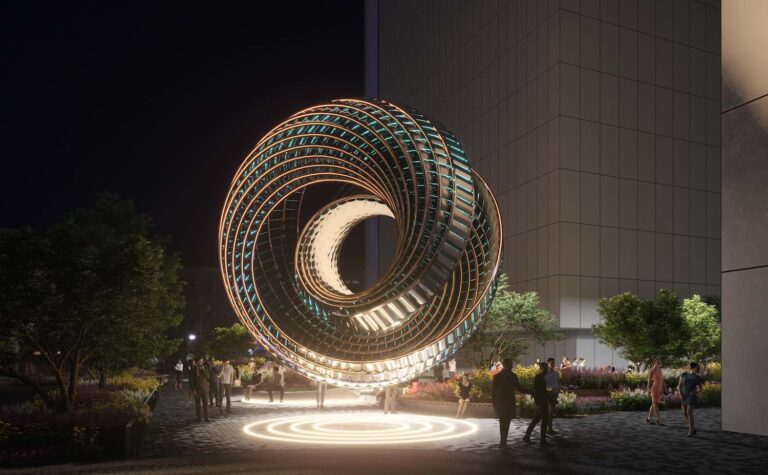
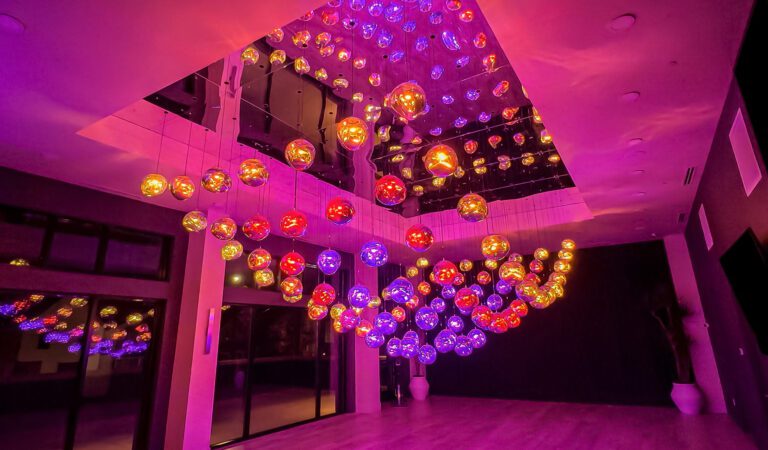
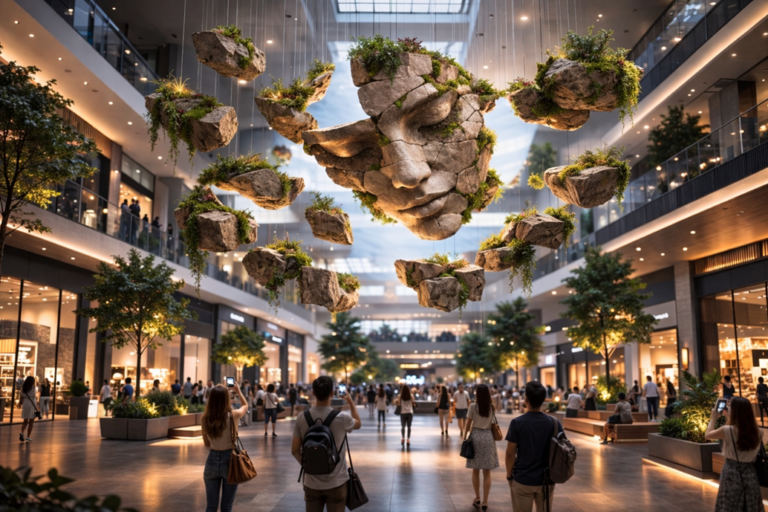
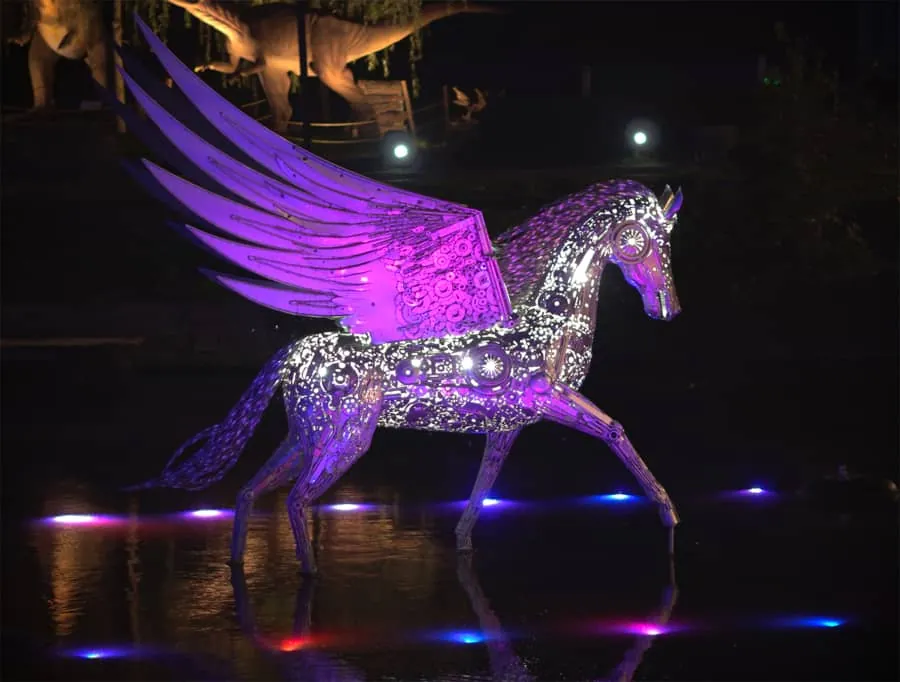
Modern art installations radically change our experience of interaction with the urban environment. Unlike traditional sculpture or painting, installation art works with space, light, sound, movement, and often includes interactive and multimedia elements. This is not just the design of squares: it is public art (public art), which transforms locations – from airports to waterfronts – into cultural landmarks and immersive environments.
For quick examples of large works and kinetic solutions see portfolio .
History and evolution of public art
The origins of the genre go back to the avant-garde of the early 20th century, when artists began to go beyond the canvas and pedestal, turning space itself into a material. By the middle of the century, this trend had become stronger, and in the 1960s and 1970s, Allan Kaprow with his happenings and Christo and Jeanne-Claude with monumental temporary projects changed attitudes to scale, time and viewer participation.
The end of the 20th century brought technologies: LED light, video projection, sound environments, sensors and kinetic mechanisms. Installations began to respond to people and context, and cities began to use public art as a tool for renewing the environment and shaping the identity of places.
Today, installations explore themes of climate, migration, digital reality and identity, bringing together art, architecture, engineering systems and urban design.
Key features of modern art installations
- Immersion and Experience
The installations create multi-level sensory scenarios: light fields, acoustic landscapes, tactile structures, kinetic surfaces. The viewer ceases to be an observer and becomes a participant, forming his own trajectory of perception.
- Integration into the environment
Installations are designed uniquely for each location, harmoniously integrating into the architecture, landscape, history and audience. Hence the deep resonance with the community and the ability of the work to become an urban symbol. More details about this approach can be found in the section Public art .
- Multimedia and interactivity
Modern projects combine projections, light, sound, mechanics, AR/VR, motion and presence sensors. Thanks to this, the work changes over time, responding to the behavior of viewers and environmental conditions. Practical examples – in the section Kinetic installations
Visionaries of the genre: artists and their methods
- Janet Echelman – fabric of wind and light
Echelman s giant aerial network sculptures reimagine the sky as an exhibition plane. Works like ” 1.8 Renwick” create meditative urban oases where light and wind are valuable materials.
- Ann Hamilton – tactile poetry of space
Project ” The event of a thread” connects textiles, sound and movement, turning the hall into a living ecosystem, where each viewer completes the work with his own actions.
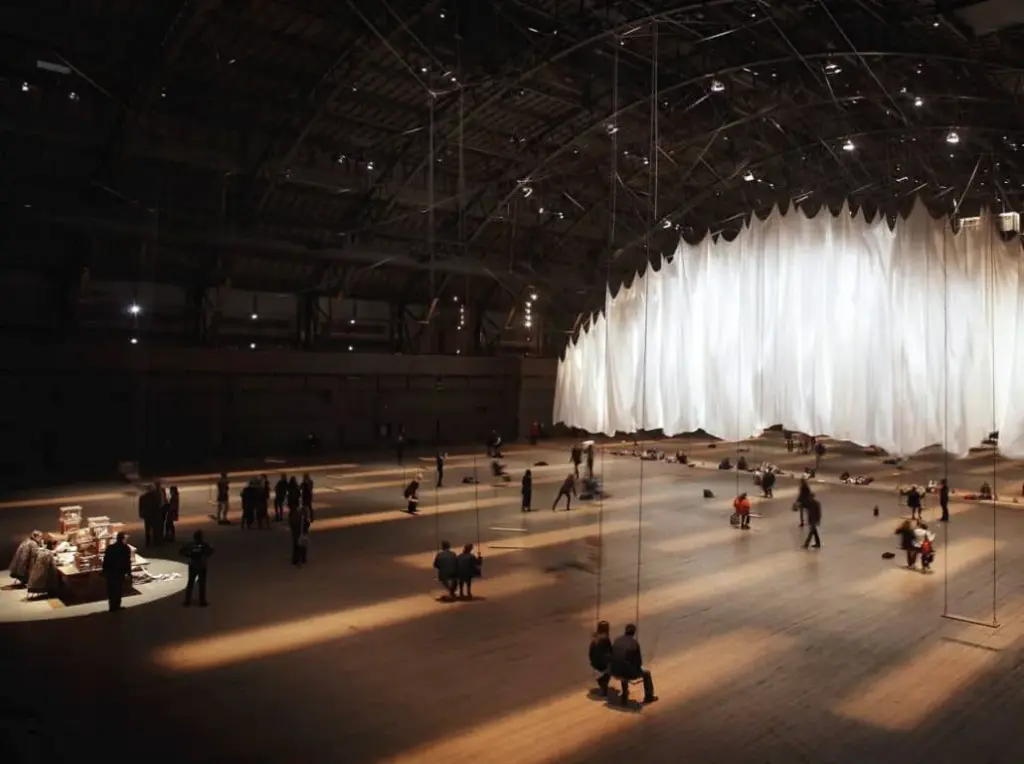
James Turrell – light like architecture

Roden Crater is an observatory of perception , where light and darkness become tools for working with the boundaries of the visible. Turrell shapes the architecture of sensation, not just the object.
Mark Bradford — social topography
The “Mithra” installation in New Orleans is a statement about community, vulnerability and resilience. Public art becomes a public dialogue and a platform for civic participation.
Iconic works: how installations shape discourse
- Janet Echelman – fabric of wind and light
Artificial Sun at Turbine Hall (Tate Modern) transforms the museum into a communal space for experiencing a natural phenomenon and talking about climate.
- Shibboleth (Doris Salcedo)
The “crack” in the Tate Modern floor as a metaphor for social fault lines: migration, colonial legacies and borders.
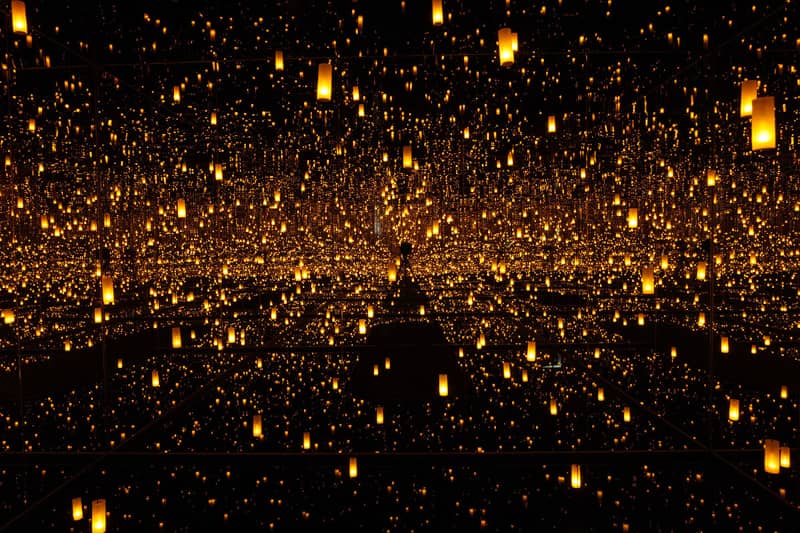
- Infinity Mirrored Room (Yayoi Kusama)
Endless mirror spaces with LED light create experience of vastness and very personal reflection.
Largest sites and institutions
- Venice Biennale is a global stage for experimental public art.
- Documenta (Kassel) – Every 5 years the city becomes a pavilion where installations are sewn into the fabric of the streets.
- Tate Modern (London) – Turbine Hall as a symbol of a monumental immersive exhibition.
- Mo MA (New York) – Exploring technology, identity, and culture through installations.
Practical value for cities and developers
Airports
Installations in terminals turn waiting time into a cultural experience, strengthen the city s brand, and set the tone for hospitality. Kinetics and light create a memorable image and are photogenic for social networks.
Embankments and public spaces
Interactive light and sound environments activate the evening scenario, increase pedestrian traffic and support the tourism economy.
Shopping and business centers
Installations form recognizable points of attraction, increase average stay time and audience loyalty, and integrate with brand storytelling.
Civic centers, museums, campuses
Public art becomes an infrastructure of dialogue, where citizens receive a platform for shared experience, and institutions receive a strong cultural signal.
Economic and cultural impact
Installations increase the visibility of the city, create reasons for visits, appear in guidebooks and social media feeds, stimulating small businesses nearby. In many place development strategies, public art is key to a sustainable place brand and improving the quality of urban life.
Preservation and operation: from idea to long life of a work
Engineering is half the success: materials, anti-corrosion coatings, wind and snow loads, maintainability and energy efficiency. For live projects, a service model is important: maintenance regulations, access to nodes, updating software for lighting/media. A properly designed installation will last for years while remaining safe and relevant.
The future: technology, sustainability, participation
AR/VR and mixed realities will add layers of meaning on top of the physical object; renewable energy and recyclable materials will become standard; and participatory practices will enhance co-creation with citizens. Installations will become smarter by connecting to city data and climate sensors.
Conclusion
Modern art installations are more than decor. It is the language of the city that speaks of values, history, future and people. They connect art, technology and communities, transforming space into an experience, an idea and an event.
More materials on the topic: Public art , Kinetic installations , Blog .
Frequently asked questions (FAQ)
The installation works with space and experience, and is often interactive and multimedia; sculpture is often autonomous.
It sews the work into the context of the place, enhancing the meaning and connection with the audience.
Yes, with proper engineering and materials, installations are designed for long-term operation.
LED systems, sensors, projection video, kinetics, AR/VR, as well as media servers and schedule/script control.
They create new points of attraction, increase media visibility, add evening scenarios and stimulate nearby businesses.
Author of the article