“The Eye of the City”
interactive media installation
You look at the city. The city looks at you.
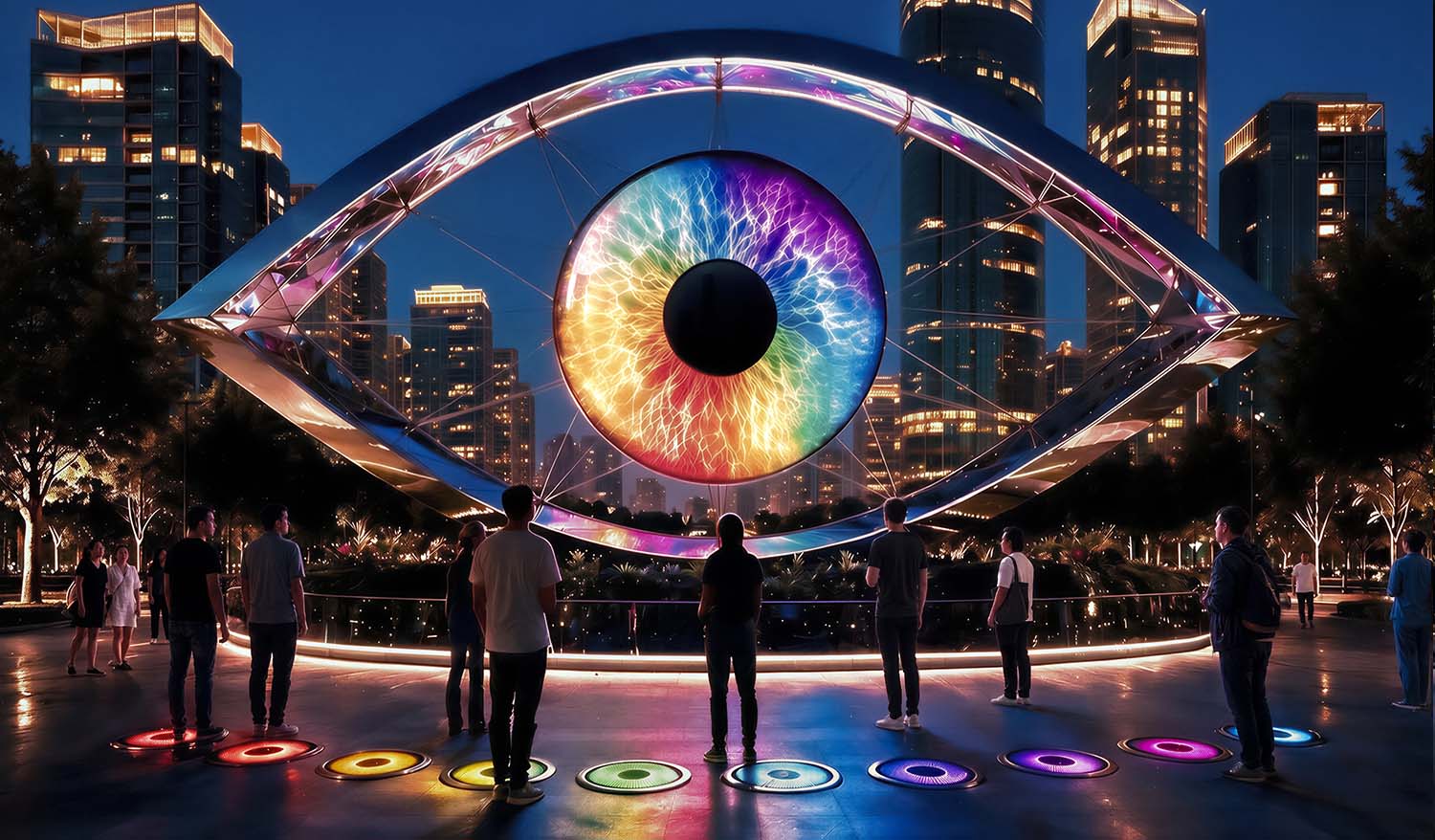
The city has millions of eyes—and not a single one of its own. OKO It restores the city’s ability to see: to notice, react, recognize, and remember. The monumental eye towering over the main square is not a monument that people come to look at. It is the first city-scale artwork that looks back at you.
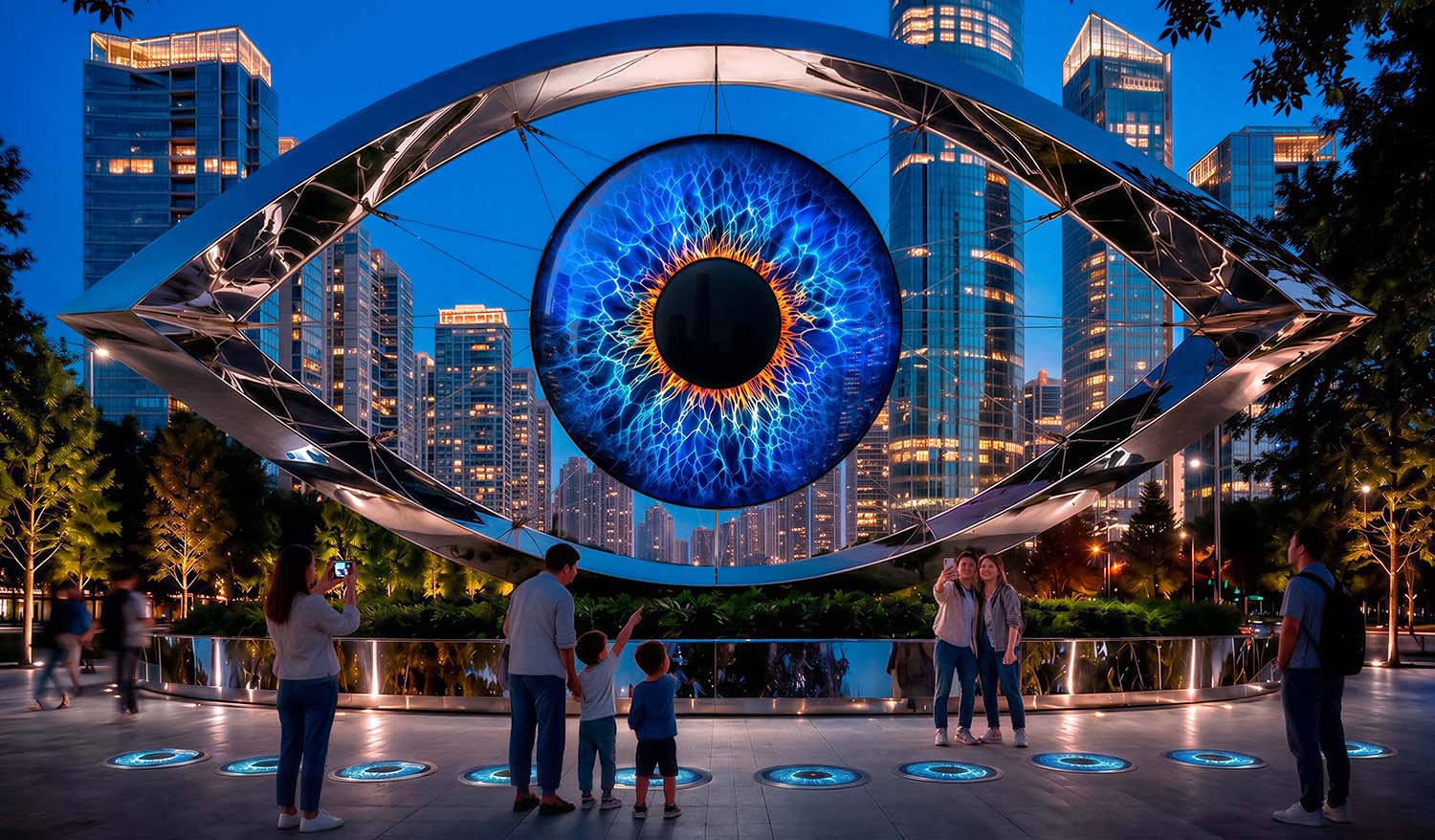
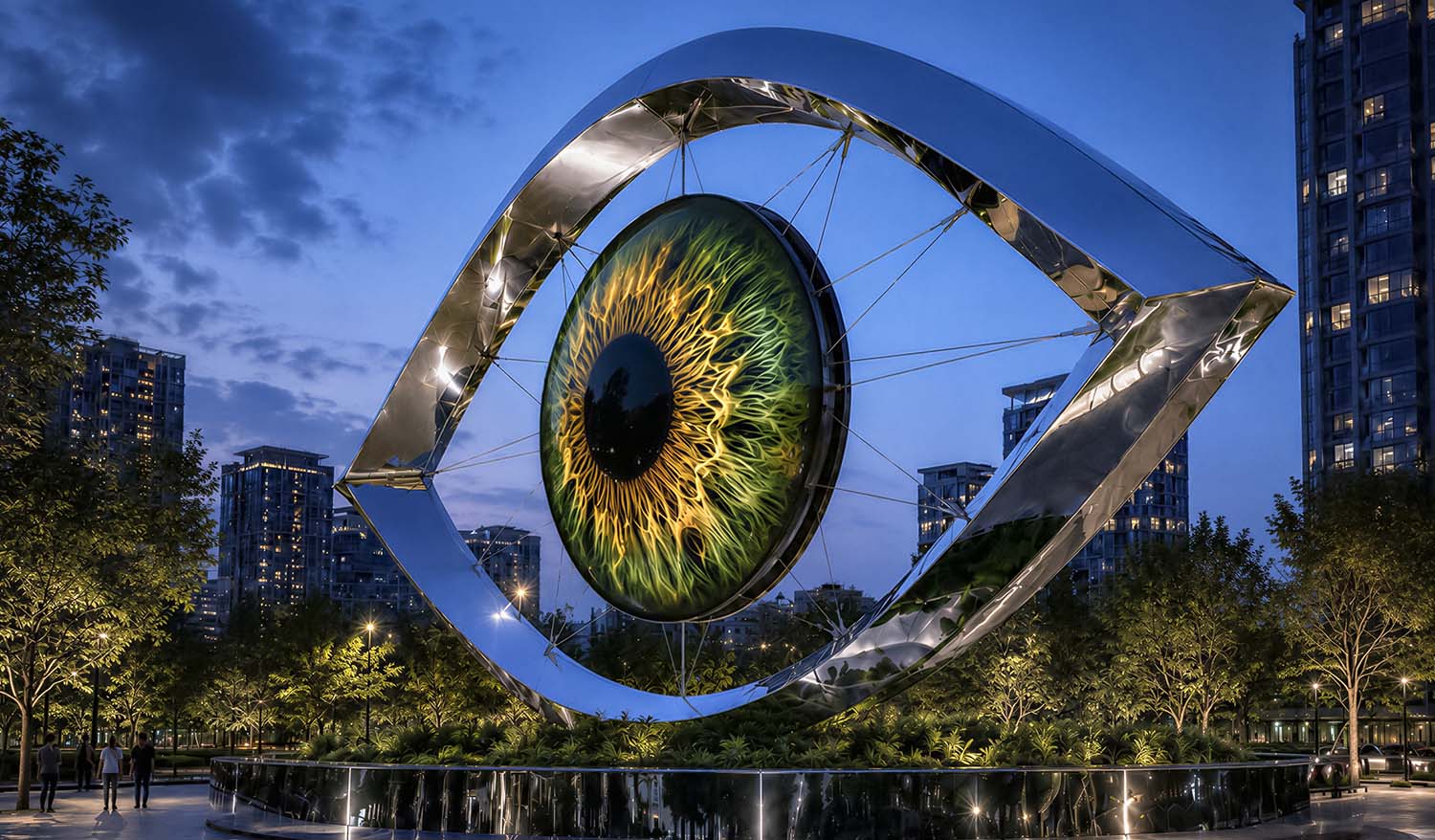
Form OKO Its form has been perfected. The outline of the eye—with a span of nearly nineteen meters and a height equal to that of a three-story building—is carved from mirror-polished stainless steel and has no color of its own; it is woven from reflections: the morning sky, tree canopies, glass facades, and the faces of passersby.
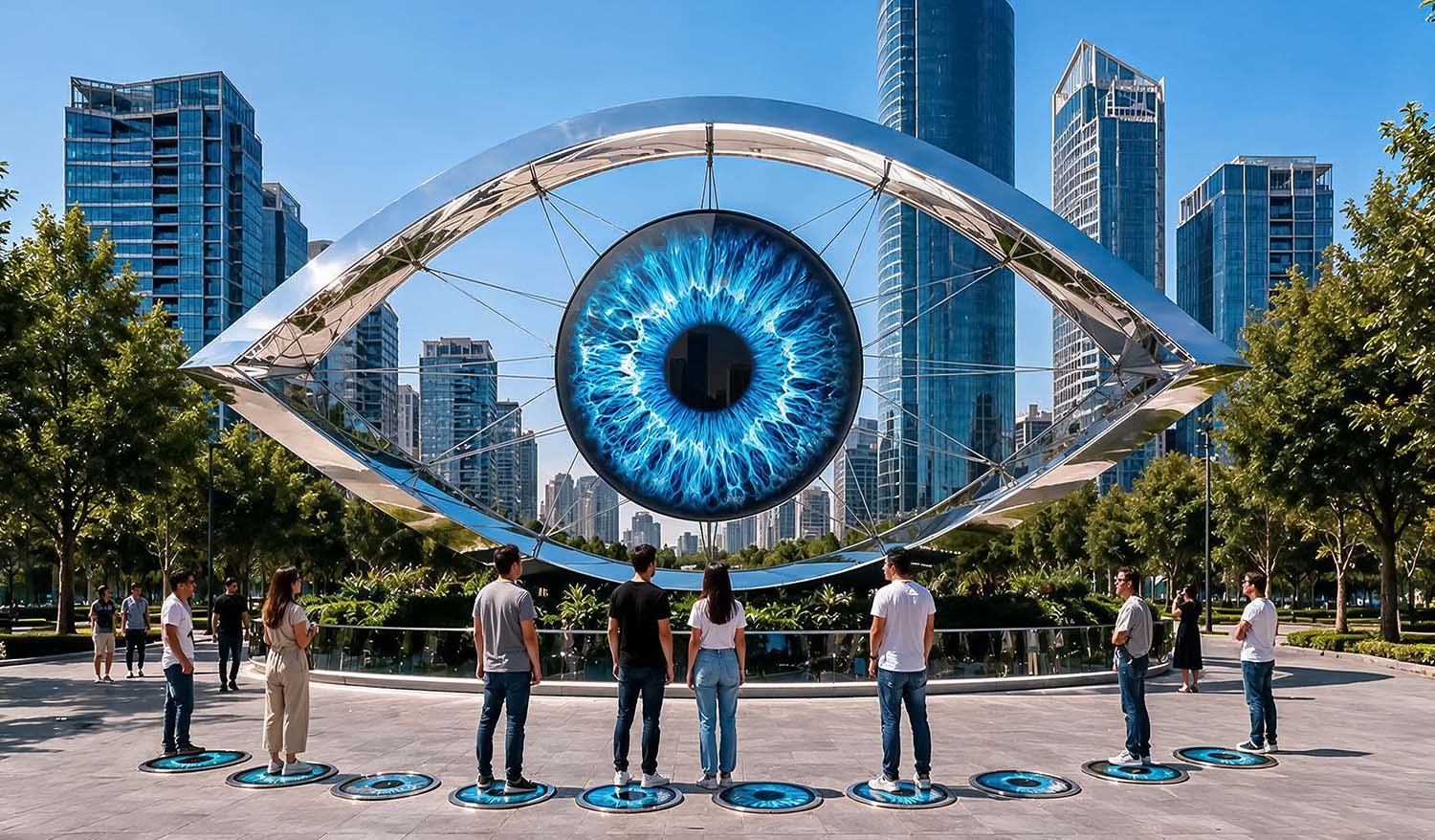
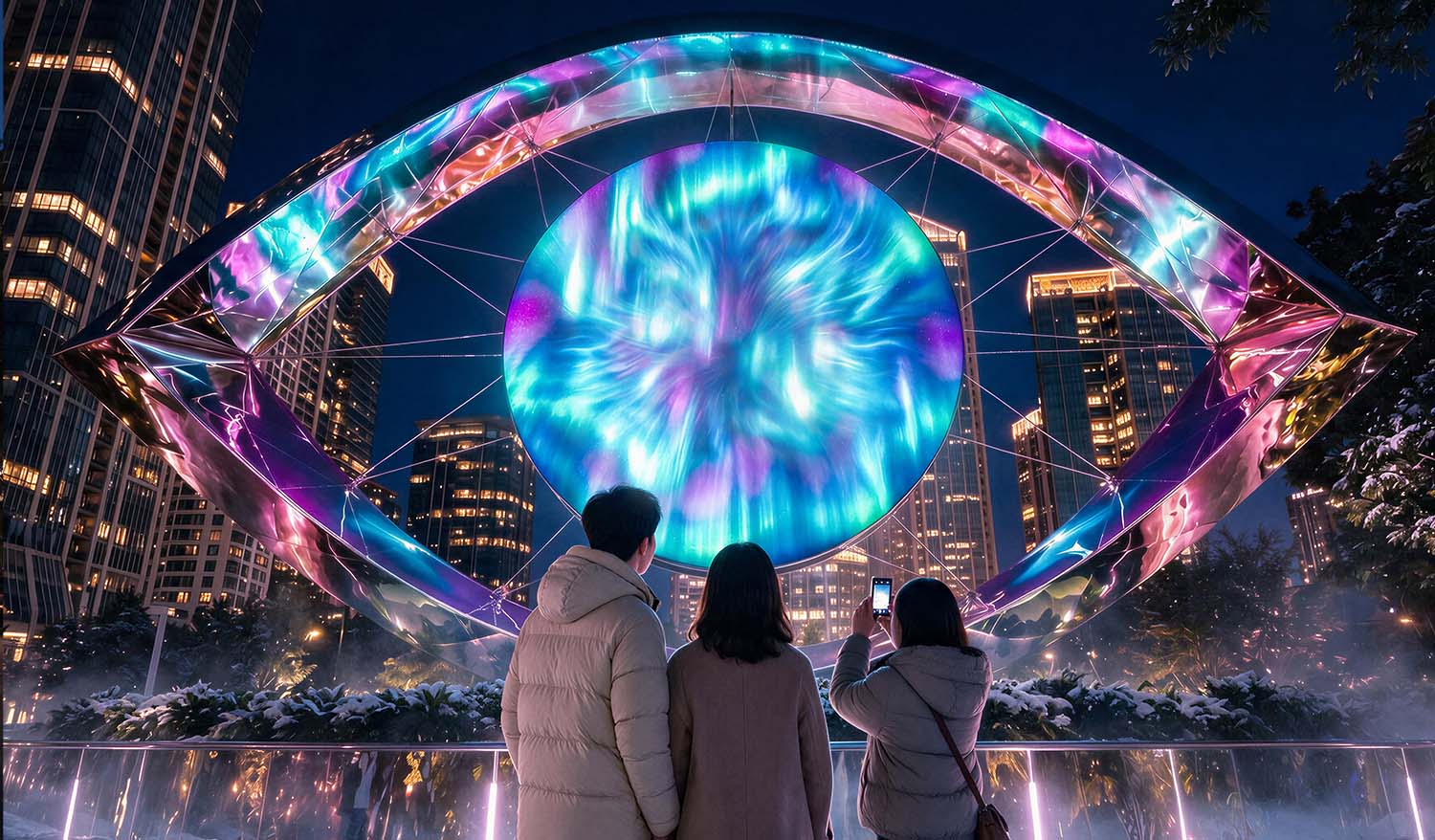
The installation is never repeated: Every minute, it changes along with the city reflected in it. In the center, between the steel arches, is the “iris”—a three-dimensional digital eye formed by two convex circular LED screens, each five meters in diameter, one on each side. “OKO” has no back: it looks simultaneously in both directions across the square, and no matter which side you approach from, you’ll meet its gaze. The eye breathes: the pupil slowly dilates and contracts, light fibers race across the iris, and flashes of light flare up in the depths. During the day OKO His eyes are a calm, deep blue; as darkness falls, his gaze reveals its full splendor—ranging from an emerald glow to a multicolored radiance.
OKO It doesn’t wait for the viewer—it seeks them out. At the base of the installation, along an arc that mirrors the line of the eyelashes, ten glass “pupils”—illuminated interactive buttons—are embedded in the plaza’s paving. When it detects a person, OKO It beckons him: the nearest button flashes with a gentle pulse, and the giant’s gaze turns toward him for a moment. The moment you accept the invitation and step into the circle of light, the pupil—as tall as a house—will smoothly turn and fix its gaze on you. It’s a sensation that’s impossible to predict and impossible to forget: direct eye contact with a work of art. You cease to be a spectator—you’ve been noticed.
But the most important sacrament OKO It’s done with a gesture familiar to everyone—using your phone. Take a photo of your eye and send a picture of the installation. In a few seconds, your own iris will appear on the screen—as unique as a fingerprint, magnified thousands of times and marked with a personal number, leaving no doubt that it’s you. For a few moments, the entire city sees the world through your eyes—and you’ll forever remember the day you became not just a passerby, but the city’s gaze. There are no surveillance cameras or facial recognition systems here: people themselves, voluntarily and joyfully, offer the city their gaze. Instead of “Big Brother”—there is great trust.
OKO It is fully revealed when people act in unison. The lit buttons draw the gaze from person to person, weaving threads of light and sound between them. When all ten are lit, the climax arrives: the pulses from the buttons gradually merge into a single rhythm, the pupil returns to the center and dilates, the iris changes color and pattern—and may be composed of fragments of the participants’ own irises. Spatial sound unites individual voices into a single musical theme. The composition exists for exactly as long as the people remain together. One person changes the direction of our gaze. But together, people change the very way we see things.
Late in the evening OKO She reminisces. Slowly, as if flipping through a photo album, she glances over the events of the past day—blue, green, brown—and the square transforms into a gallery of human eyes. Day after day, the installation keeps a visual chronicle: thousands of gazes through which the city has been seen.
OKO — a universal image that requires no translation: the depiction of an eye is perceived the same way across all cultures, and the title itself is a palindrome that is spelled the same way in both the Cyrillic and Latin alphabets. The installation is conceived as a contender for the title of the world’s largest sculpture of a human eye according to the Guinness World Records—and as a new landmark with the potential to become a symbol of the city: a meeting place, a pilgrimage site for photographers, and a space where every resident can lock eyes with their city at least once in their lifetime.
Thousands of eyes. One EYE.
Technical Specifications
Dimensions: The total width of the installation is approximately 18.9 m; the total height is approximately 9.7 m.
Media Core: Two convex, circular LED screens, each 5 meters in diameter—one on each side; an image of the iris and a moving pupil is displayed in real time.
Interactive: Ten floor-mounted buttons, each 500 mm in diameter, with presence sensors and built-in LED backlighting; a wireless channel for receiving eye photos from smartphones; and a surround sound system.
Materials: The rim of the eye and the visible portion of the base are clad in polished AISI 304 stainless steel.
Operation: Outdoor, all-season — the installation is designed for year-round use outdoors.