INTERACTIVE INSTALLATIONS
for urban and public spaces

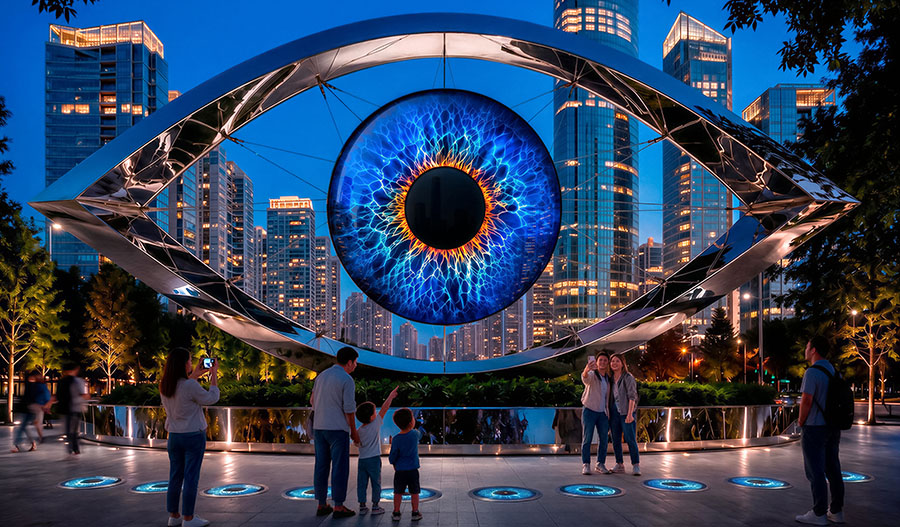
Today, in all developed countries, interactive installations have become a powerful tool for shaping urban identity, attracting tourists and turning ordinary streets into unique points of attraction. At SKYFORM STUDIO we create interactive art objects that become real symbols of the city. Combining bold artistic vision, advanced materials and engineering precision, we create designs that engage, surprise and remain relevant for decades to come.

Why do we need interactive installations?

An interactive installation is not just a decoration, but an infrastructure of experiences that increases the value of the territory and provides a measurable effect for the city and business.

  • Forms the identity of the city – creating a recognizable symbol and “calling card” of the location.
  • Stimulates the economy by attracting tourists and increasing the interest of investors and developers.
  • Gives a media effect – generating organic PR, reach in social networks and a flow of UGC content.
  • Raises the status of the city – creating an image of an innovative and attractive space.

Our approach to creating interactive installations

At SKYFORM STUDIO we combine creativity and engineering technology to create durable and expressive art objects:

  • Individual concepts that reflect the spirit of the city and the context of the place.
  • Materials resistant to weather conditions and time.
  • Interactive elements that engage residents and tourists.
  • Full cycle: from idea and design to installation and maintenance.
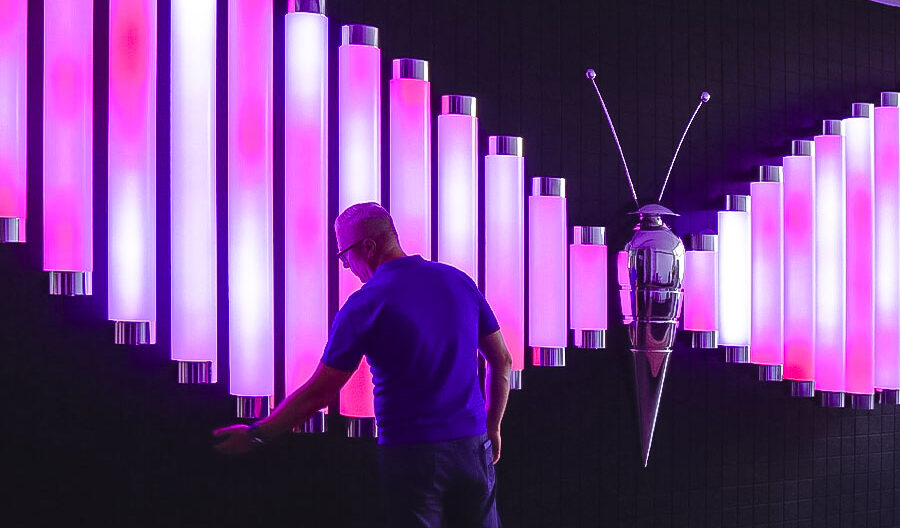
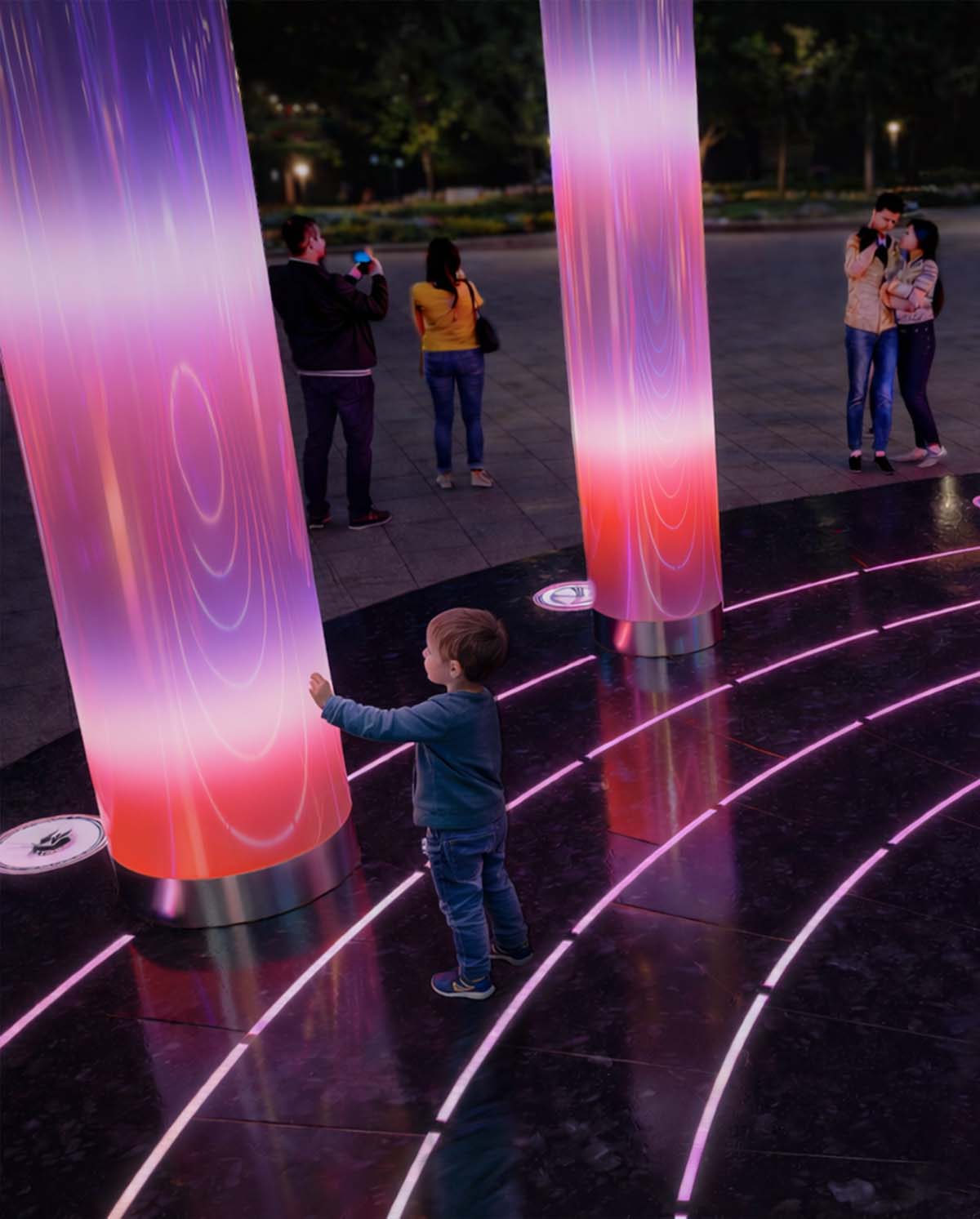
An interactive light installation in an urban space: a child touches a glowing column with dynamic pink-purple gradients, surrounded by light lines in a granite coating and visitors interacting with the object in the evening.

OUR CONCEPTS FOR INTERACTIVE INSTALLATIONS

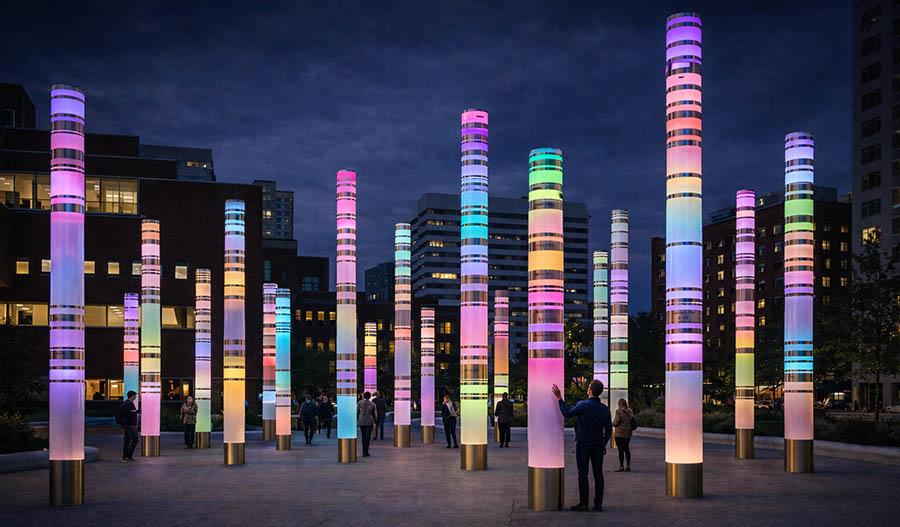
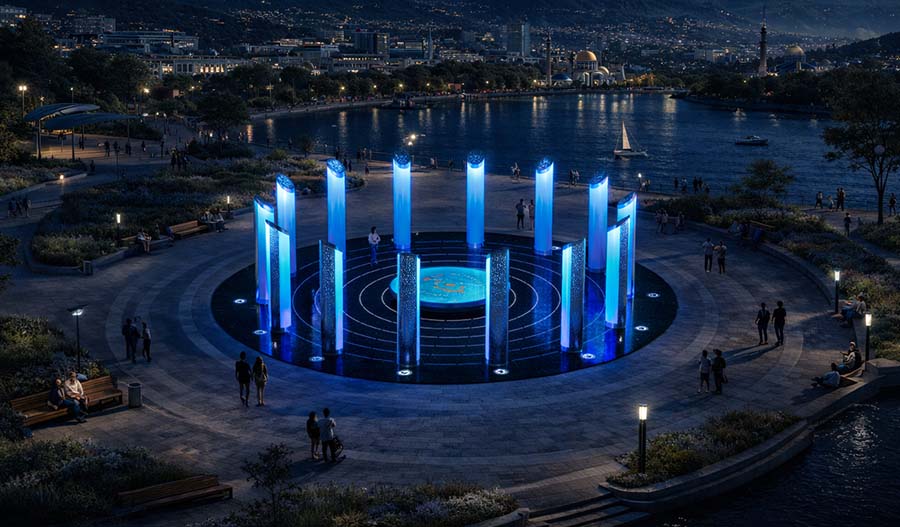
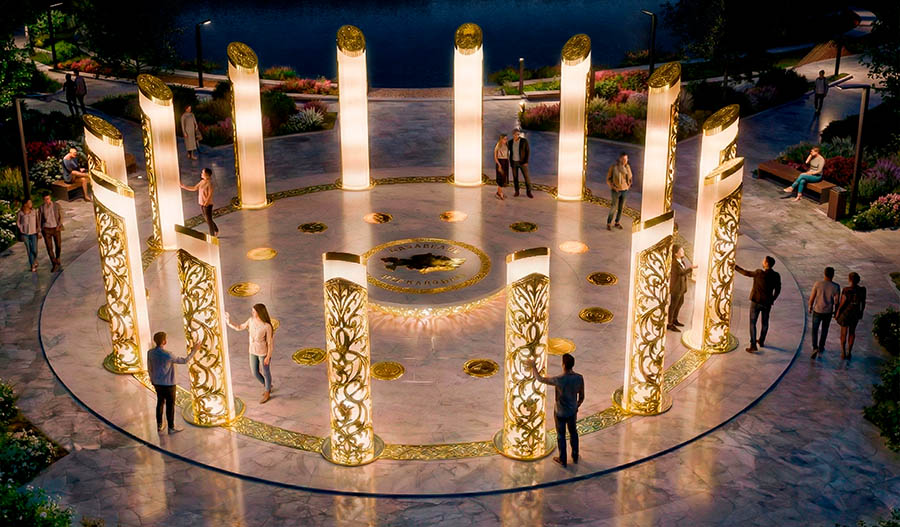
“Wealth of the Nation” is a monumental light and music installation that reveals the key national values ​​of Kazakhstan through architecture, light and sound. 14 four-meter columns located in a circle with a diameter of 14 meters form an integral public space, where a person becomes the center of the composition and an active participant in what is happening.


Each column symbolizes one of the country’s riches – from historical foundations to modern landmarks – and has its own light and sound identity. When touched, a dynamic scenario is launched: the light rises vertically, and the space is filled with a unique sound fragment.


In the center there is a podium with a relief map of Kazakhstan, uniting the territorial and semantic image of the country.

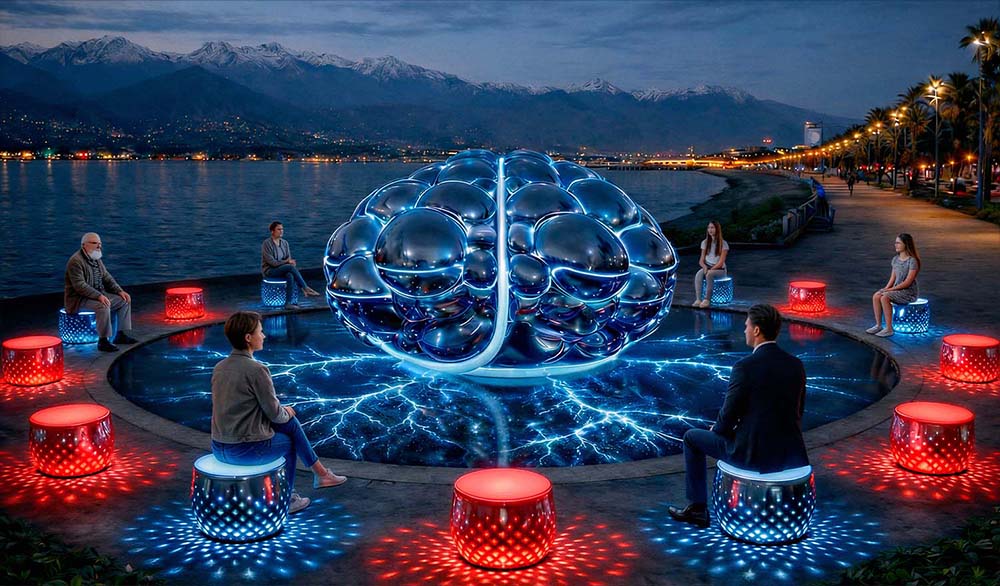
GLOBE MIND is a mirrored interactive brain-shaped sculpture controlled by artificial intelligence. It reacts to a person with light, sound and “neural” impulses, turning touch and presence into a living dialogue. Every 30 minutes an AI show starts, forming a new city habit – meeting at GLOBE MIND at regular times.


The project unites cities into a single intelligent network: each installation is a City Edition, unique in design, but connected by a common system. People come here not only to be impressed, but also to “send” their desire to the Global Mind – making their city part of the world map of human consciousness.

“Wealth of the Nation. Contemporary” is a modern light and music installation dedicated to the national values ​​of Kazakhstan. 14 light columns form a circle of values ​​- a space of unity, where a person finds himself in the center of the composition.


Each column has its own light and sound identity: when touched, an individual script is activated, and perforated codes form an image of the digital DNA of the country.

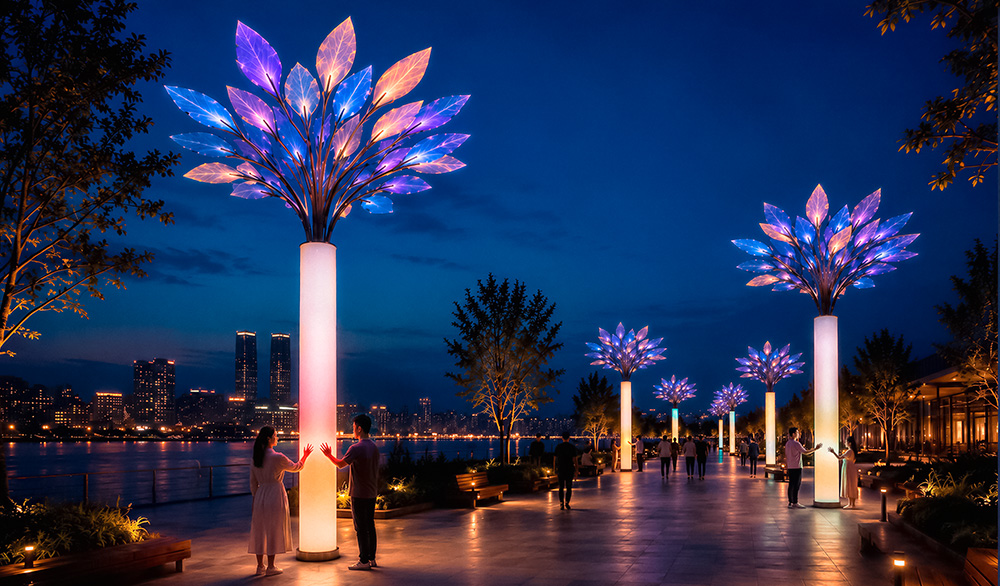
“Magic Tree” is a large-scale interactive light sculpture created for modern public environments. Combining expressive design, premium materials, artistic illumination, and touch-responsive technology, the installation transforms ordinary spaces into memorable destinations.

During the day, the object appears as an elegant sculptural landmark integrated into its surroundings. After dark, it becomes a luminous artwork that creates a sense of wonder, attracts visitors, and serves as a distinctive focal point for photography and social interaction.

More than a decorative installation, Magic Tree is designed to encourage emotional engagement between people and public space.

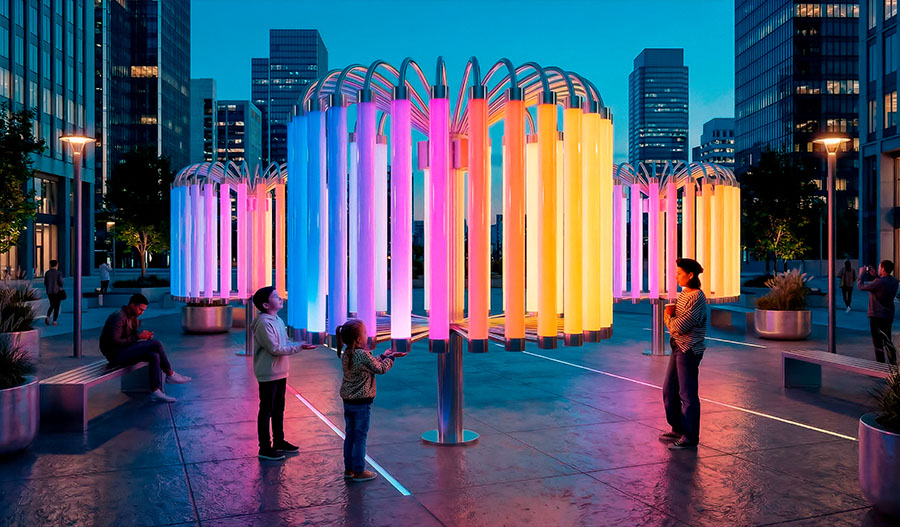
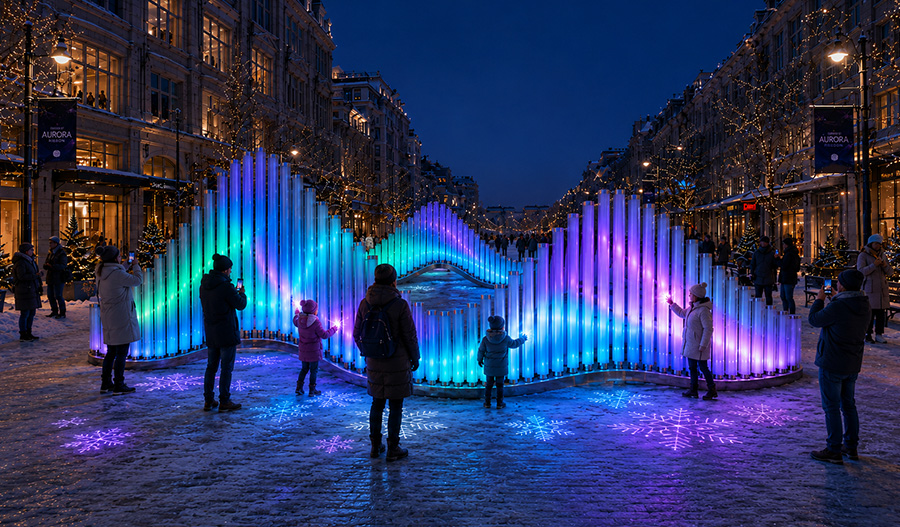
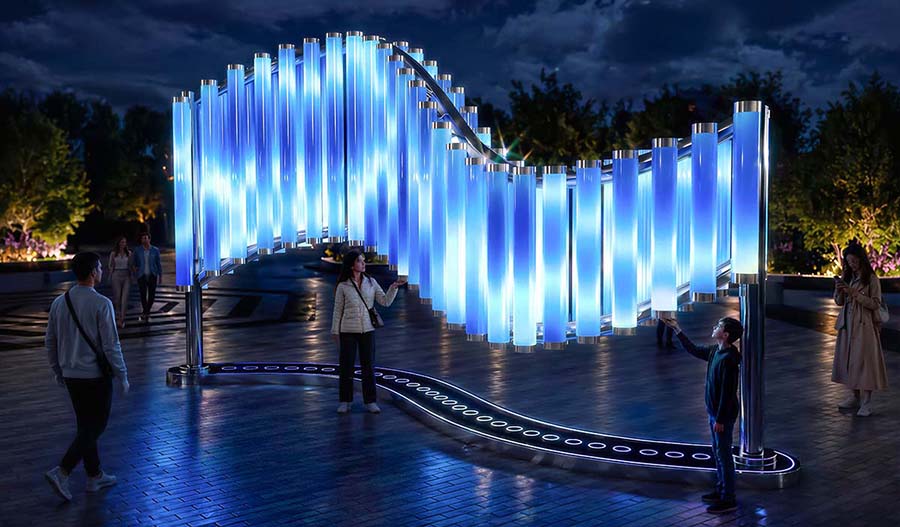
“Northern Lights” is a contemporary interactive light installation inspired by one of nature’s most captivating phenomena — the aurora borealis.

The project takes the form of a flowing wave composed of illuminated vertical polycarbonate tubes arranged directly within public space. Visitors can walk around the installation, experience it from different perspectives, and interact with it through touch.

Soft transitions of blue, turquoise, white, violet, and pink light create the impression of a living luminous landscape. In its ambient mode, light slowly travels through the structure, recreating the fluid movement of the northern sky.

Rather than functioning as a traditional decorative object, Northern Lights transforms its surroundings into an immersive winter environment where light becomes a dynamic and interactive medium.

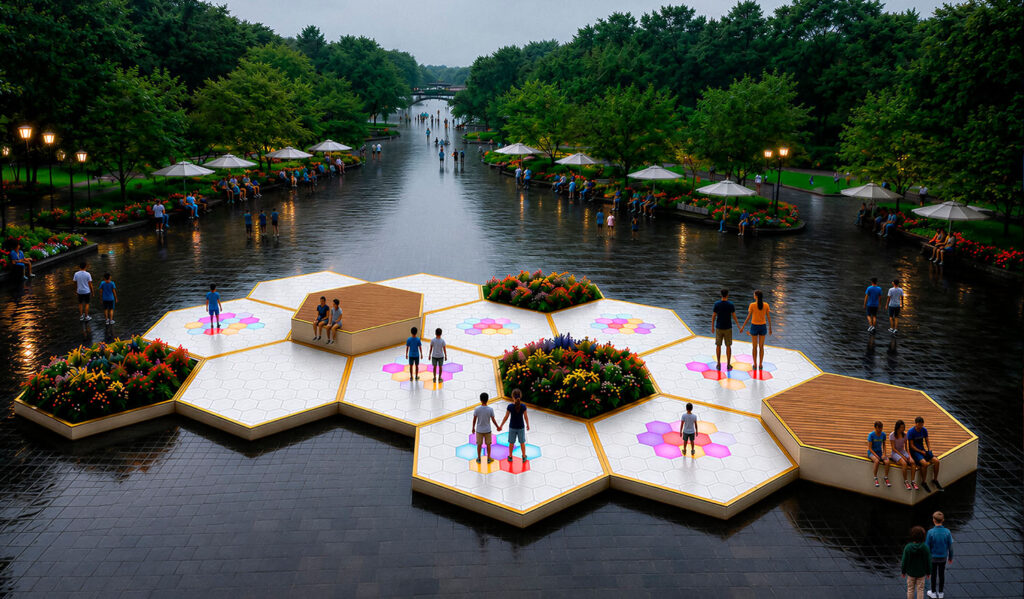
“LUMISTEPS” is a modular interactive installation that combines play, technology, light art, and public engagement within a single environment. Designed for both children and adults, it transforms everyday spaces into dynamic destinations where movement directly influences light and sound.

Rather than observing the installation, visitors actively shape the experience. Every step, jump, or movement triggers visual and audio responses, creating an environment that continuously evolves through participation.

During daylight hours, LUMISTEPS functions as a contemporary architectural feature. After dark, it becomes a vibrant illuminated landmark that attracts attention and encourages interaction.

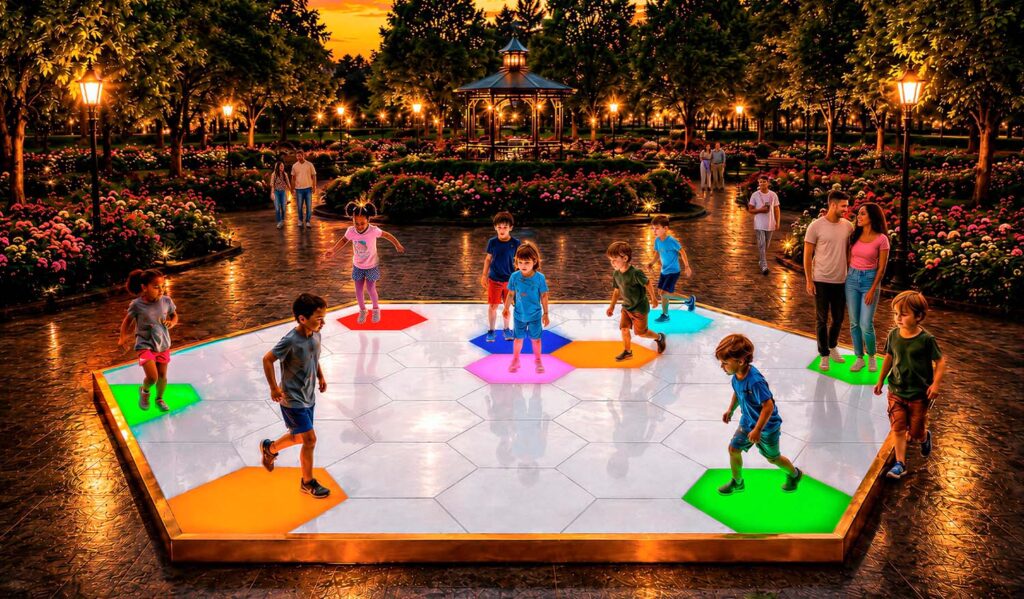
“HONEYCOMBS” is an interactive installation that transforms an ordinary public space into a dynamic environment where visitors can engage through movement, light, color, and sound.

The project combines the qualities of a public artwork, an interactive playground, an architectural feature, and a technology-driven attraction. Rather than simply observing the installation, visitors actively participate in the experience by stepping onto illuminated elements, triggering audiovisual effects, creating their own patterns of interaction, and engaging with others.

By day, HONEYCOMBS presents itself as a contemporary geometric landscape. After sunset, it becomes a vibrant illuminated destination that attracts attention from across the site.

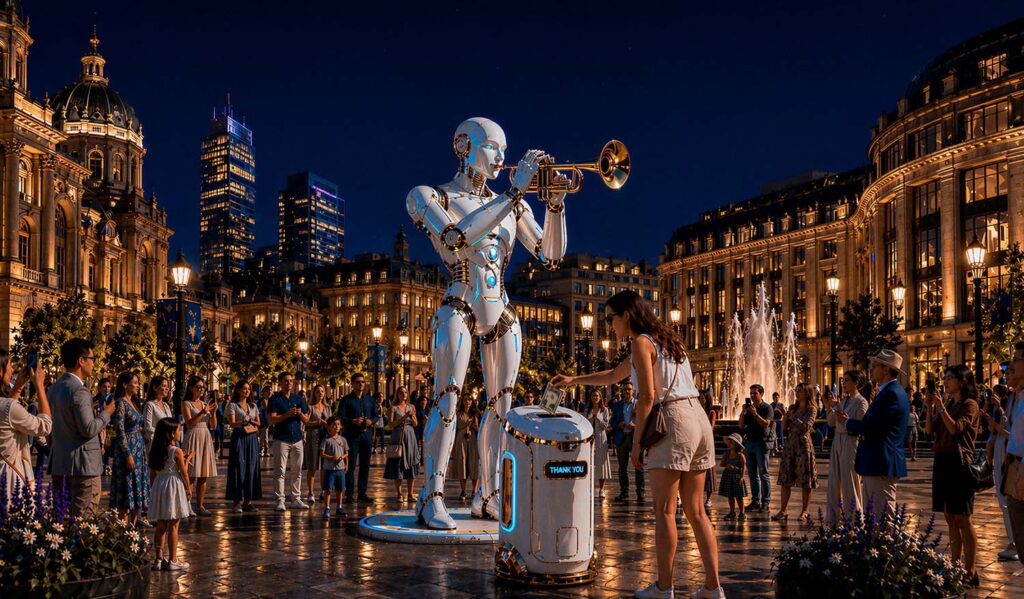
“STREET MUSICIAN OF THE FUTURE” is a 4-meter-tall interactive installation that transforms public space into a living stage. Combining sculpture, robotics, music, lighting, and audience participation, the project reinterprets the familiar experience of a street performer through the lens of future technologies.

Standing prominently within the urban environment, the robotic musician appears as if it has arrived from another era. Equipped with a trumpet, articulated shoulders, and moving wrists, it creates the illusion of a live mechanical performance. Music is delivered through a dedicated sound system positioned in front of the installation, while synchronized movement, lighting, and audio merge into a unified spectacle.

More than a visual icon, Future Street Musician is designed to make technology approachable, emotional, and engaging. The robot performs for the public, gathers people around itself, and introduces a simple interactive ritual: when visitors support the performance, the musician acknowledges them and continues playing. At certain moments, it may fall silent and remain motionless, waiting for human interaction before coming back to life.

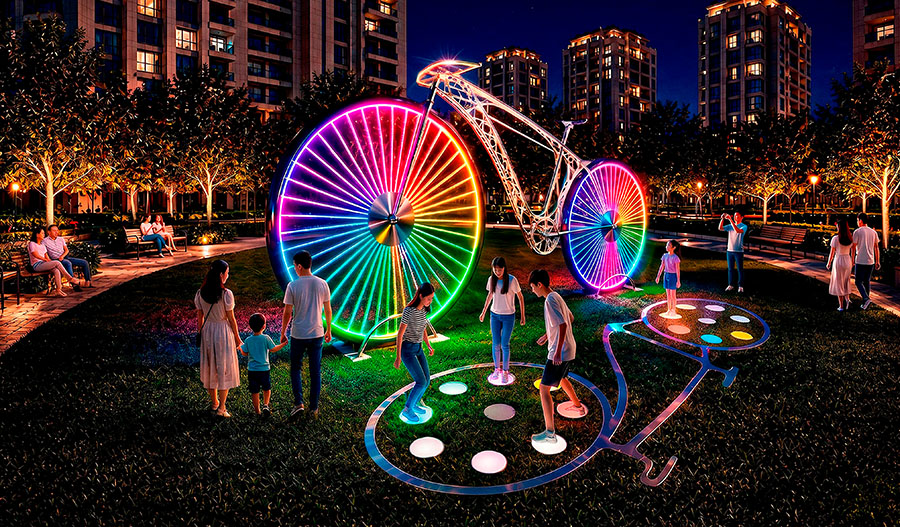
“BICYCLE” is an interactive installation designed in the form of a large bicycle, created to become a recognizable symbol of a contemporary residential development.

The installation combines architectural sculpture, interactive lighting, engaging play mechanics, and a striking photo destination. Rather than simply decorating the surrounding area, it encourages activity: visitors approach the installation, interact with it, take photographs, play together, and spend time in the space.

During the day, BICYCLE is perceived as an expressive urban sculpture. After sunset, it transforms into a dynamic illuminated installation: the wheels become filled with color, the outline begins to glow, and the interactive buttons activate a variety of lighting scenarios.

BICYCLE can serve as a visual landmark for the development—a memorable object that people associate with a modern, vibrant, and technology-driven living environment.

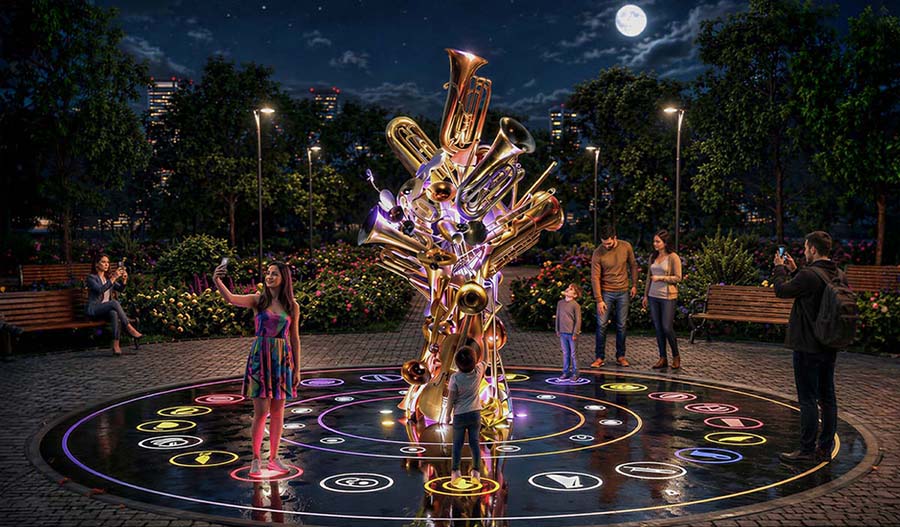
“Orchestra” is an interactive urban installation where a person becomes a musician of space. The 3.25 m high central sculpture, assembled from 63 musical instruments, symbolizes harmony and unity – both in the orchestra and in the city.


Touch buttons are built into the granite platform: by stepping on them, visitors amplify the sound of individual instruments, forming a live composition in real time. The music comes from within the sculpture thanks to an all-weather acoustic system, while light rings and lighting respond to the rhythm, creating a completely immersive experience.


“Magic Flows” is an interactive light and sound installation where space responds to a person. Two undulating lines of 50 light columns create a dynamic structure associated with water flow, sound vibration and digital signal.


As viewers approach, the light intensifies, individual impulses appear and notes sound—the object turns into a musical instrument that responds to touch.

“Light of Ages” is a sound and light installation that unfolds twenty centuries of Kazakhstan’s history through the language of light and space. A composition of 20 columns forms an “architecture of time,” where each era resonates with its own rhythm and character.

The height of the columns reflects the demographics of each century, while golden rings symbolize the memory of generations. Upon touch, a unique light and sound response is triggered, transforming history into a personal dialogue with the past.

FAQ: INTERACTIVE INSTALLATIONS for cities and businesses

1. What is an interactive installation?

An interactive installation is an art object or space that reacts to person and environment in real time: touch, steps, gestures, presence, sound. Unlike static sculpture, interactive work “comes to life” in interaction with visitors and turns them from spectators into participants.

In practice, interactive installations are often used as experience infrastructure: they form recognition of a place, create a “point of attraction”, give a media effect (UGC/social networks) and strengthen the image of the territory or brand.

2. What types of interactive installations exist?

Interactive installations can be classified according to interaction scenario and by to the medium.

By way of interaction:

  • Motion/Presence Response (the installation “feels” a person in the zone).
  • Response to touch (touch triggers, personal light/sound feedback).
  • Reaction to steps (floor panels, touch tiles, interactive routes).
  • Interactive via smartphone/digital layer (mobile scenarios).

By medium and technology:

  • Interactive light (DMX/LED systems, dynamic scenarios).
  • Light + sound (soundscapes, music, reactions to noise/voice).
  • Interactive kinetics (moving elements that change shape when interacting).
  • Immersive multimedia spaces (tunnels/areas that are “switched on” by the audience).
3. How much does an interactive installation cost?

Cost is always calculated individually, because each installation is a unique combination art, engineering, architecture and technology. We adhere to the principle of transparency: after discussing the task, you receive detailed estimate (concept, 3D visualizations, production, delivery, installation and commissioning).

Key factors affecting the budget:

  • scale and dimensions;
  • complexity of design and engineering;
  • materials (glass/bronze/stainless steel/stone/polycarbonate/acrylic, etc.);
  • technologies (LED, sensors, multimedia, specialized software);
  • site and installation conditions (foundation, soil, communications, geography);
  • deadlines (tight deadlines);
  • composition of documentation and visualizations;
  • author’s artistic development.

Approximate ranges (indicative):

  • small interactive installations –100 000-200,000USD
  • medium scale – 200,000-500000USD
  • large and complex interactive installations – from500 000 USD
4. How long does it take to develop and install an interactive installation?

The timing depends on the scale and technological complexity. On average, projects take 3–6monthev, and large or technologically complex – 6–12 months.

What affects the timing:

  • complexity of the project (interactive requires development and debugging);
  • size of the facility (production, logistics, installation);
  • materials;
  • sensor/light/software integration;
  • site conditions (foundation, terrain, communications);
  • approvals and permissions.

Typical steps:

  1. concept + sketches + preliminary 3D visualization
  2. design (drawings, calculations, specifications, estimates)
  3. coordination
  4. production
  5. assembly and testing in production
  6. delivery
  7. installation
  8. commissioning (lighting/mechanics/interactive)
  9. delivery and transfer of documentation
5. Do you do 3D renderings before production?

Yes. 3D visualization is a mandatory step: It allows you to see in advance how the object will look in a real environment and agree on all decisions before production and installation.

What do 3D visualizations provide:

  • clarity of form, proportions, materials and light;
  • accuracy (models with real dimensions and engineering parameters);
  • flexibility (edits are cheaper at the modeling stage);
  • materials for presentations to investors/partners and PR.
6. How are interactive installations maintained?

Durability depends on three things: materials + engineering + regular maintenance. We design installations so that they are easy to inspect, clean and maintain.

Typically a service plan includes:

  • regular checkups,
  • surface cleaning,
  • prevention of engineering systems,
  • service support if necessary.

For interactive projects, additionally (depending on the equipment) may include checking sensors, setting up light/sound scenarios and routine maintenance on control systems.

7. What warranty do you provide?

We provide transparent warranty conditions, because public and interactive objects must be reliable and designed to last for many years.

Basic guarantee logic:

  • Central groups (static installations) – 2 years (construction, materials, finishing);
  • Structural Elements – Extended Warrantyup to 5 years (depending on the project);
  • Engineering equipment –2 years (warranty for mechanisms, light and control systems).

Warranties typically cover defects in materials, repair/replacement of components, correction of manufacturing errors, and compliance with safety and durability standards.

8. Where can interactive installations be used?

Interactive installations are suitable for urban andpublicspaces, where it is important to create a point of attraction and emotional experience.

Typical locations:

  • city ​​squares, parks, embankments;
  • airports, train stations;
  • museums and cultural venues;
  • hotels, shopping centers, public spaces of development projects.

Interactive formats work both day and night, create “instagrammable spaces” and enhance the PR effect (photo/video, UGC).

9. Do you work with architects and designers?

Yes. We actively collaborate with architects, interior designers, landscape architects and engineers to ensure installation organically integrated into architecture and the general design of space.

Cooperation formats:

  • expert consultations (format, materials, technologies, engineering);
  • joint development of the concept;
  • technical development (calculations, design diagrams, control systems);
  • production and installation;
  • designer’s supervision on site.
10. How to order an interactive installation in SKYFORM STUDIO?

The ordering process is transparent and step-by-step:

1.Primary contact:

2. Consultation: goals, audience, location, timing, budget

3. Concept + 3D visualization

4. Agreement: description of the object, terms, cost, payment schedule, guarantee and maintenance

5. Technical documentation

6. Production

7. Delivery and installation

8. Commissioning and delivery (testing, configuration, documentation, training if necessary)

TRANSFORM YOUR SPACE WITH US!

We will create an art object for you that will become a real point of attraction.

MAIN OFFICE

Skyform Studio

405 N Wabash avenue

Chicago, IL 60611

OFFICE IN KAZAKHSTAN

Skyform Studio / Aqua Engineering

Al-Farabi Avenue, 17, building 5B

BC Nurly-Tau, fl. 12, Almaty

OFFICE IN GEORGIA

Skyform Studio / Legi Ltd

Tsinubani village, st. Ialno 27

Tbilisi, 0198

MAIN OFFICE

Skyform Studio
405 N Wabash Avenue
Chicago, IL 60611
+1 (855) 323-8980

info@skyformstudio.com

OFFICE IN KAZAKHSTAN

Skyform Studio / Aqua Engineering
Al-Farabi Avenue, 17, building 5B
BC Nurly-Tau, fl. 12, Almaty
+7 (727) 311-53-82

infoKZ@skyformstudio.com

OFFICE IN GEORGIA

Skyform Studio / Legi Ltd
Tsinubani village, st. Ialno 27
Tbilisi, 0198
+995 574 029 199
infoGE@skyformstudio.com

© 2026 SKYFORM STUDIO. All rights reserved.