Modern ski resorts have long since ceased to be merely places for skiing and snowboarding. Today, they are evolving into full-fledged tourist destinations where architecture, nature, entertainment, and art come together to create a unified vacation experience.
Visitors come not only for the snow-covered slopes, but also for the atmosphere, unique experiences, and places they want to photograph and share with others.
That is exactly why interactive installations and kinetic art installations for winter resorts are becoming a promising trend in contemporary architectural design.
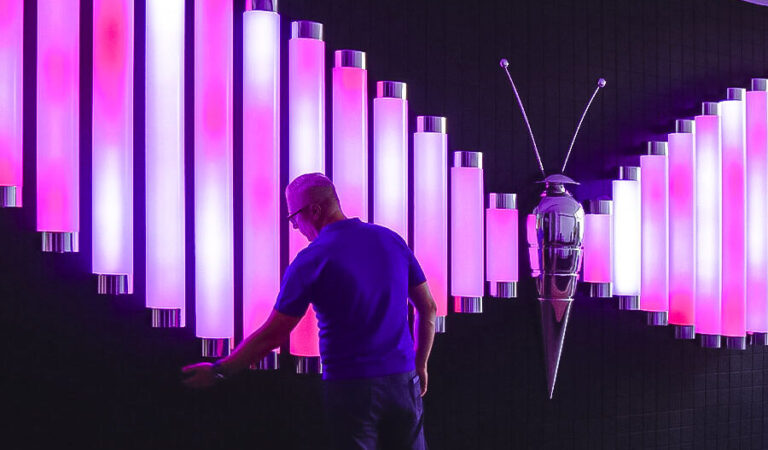
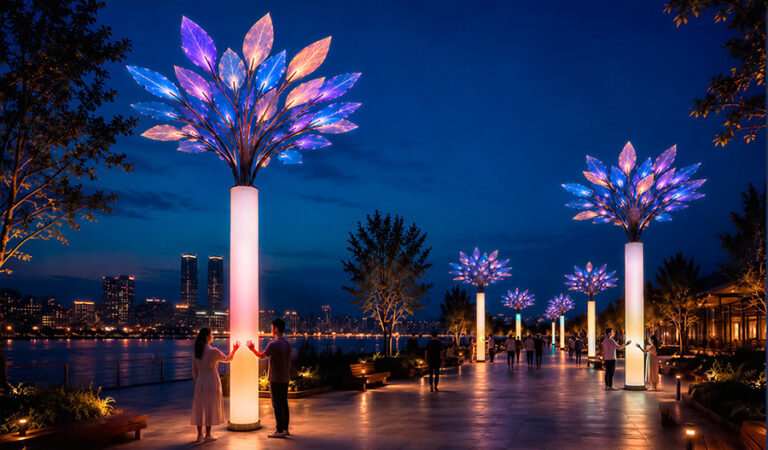
Light sculptures, moving installations, interactive pathways, and art installations that respond to human presence can transform the resort’s familiar surroundings and create an entirely new way for guests to interact with the space.
For architects and developers, this is an opportunity to combine artistic expression, innovative technologies, and the commercial objectives of a tourism project.
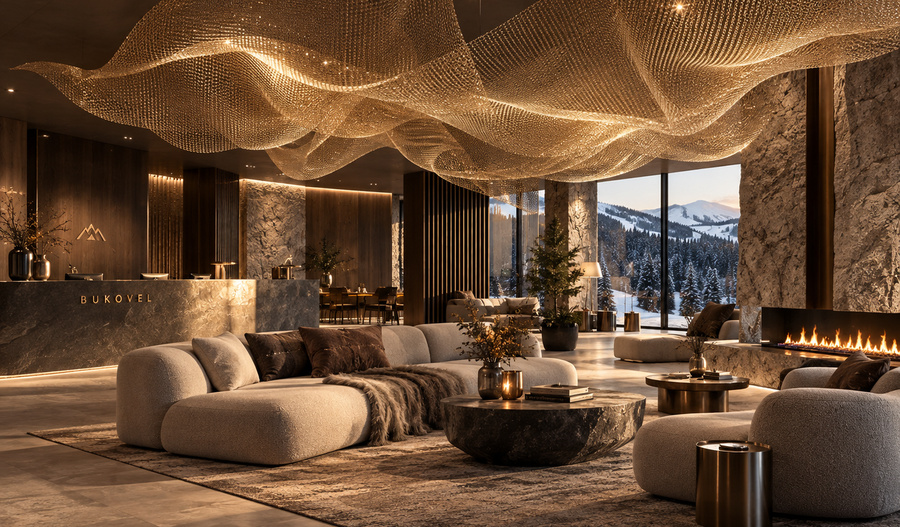
Ideas for Architectural Accents in a Lobby: A Kinetic Ceiling
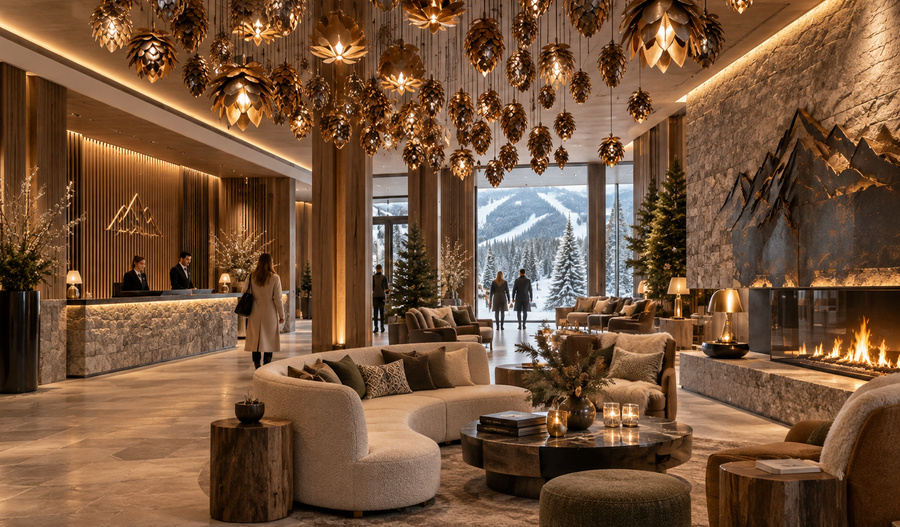
The high ceilings in hotel lobbies and atriums open up possibilities for large-scale suspended kinetic installations. Individual elements can move independently of one another, rising and falling to form various spatial compositions.
The choice of hanging decorations is virtually unlimited. They can include pinecones typical of the surrounding natural environment, snowflakes, ice crystals, skis, or abstract shapes inspired by the mountain landscape.
An artistic concept can be built around the unique features of a specific resort: natural materials, local vegetation, the history of winter sports, or recognizable elements of the surrounding landscape.
This is particularly interesting the ability to replace suspension components seasonally. The kinetic system remains the same, but its artistic content changes. In winter, these might be snowflakes and ice formations; in spring, flowers; in summer, leaves and natural motifs; and in fall, pinecones and other elements of the forest landscape.
Guests who return to the hotel during different seasons see a new design each time. The interior is given a fresh look without the need for renovations or changes to the main structure. To achieve this, the mounting system and lifting mechanisms are designed from the outset to allow for the safe replacement of suspended objects.
Interactive ski tracks for the entrance path
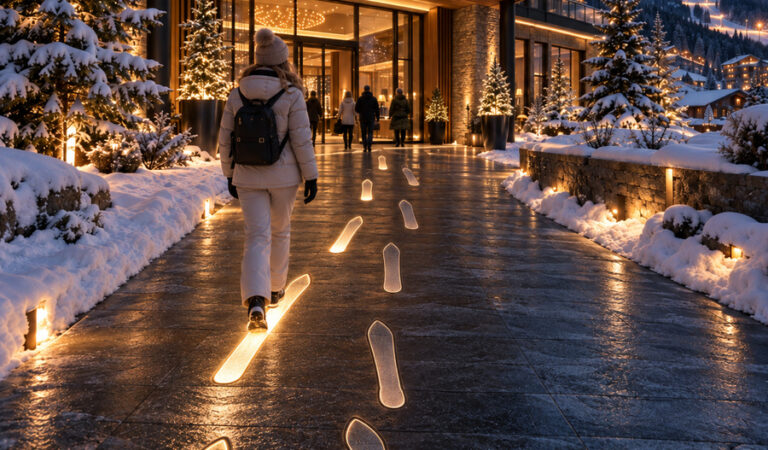
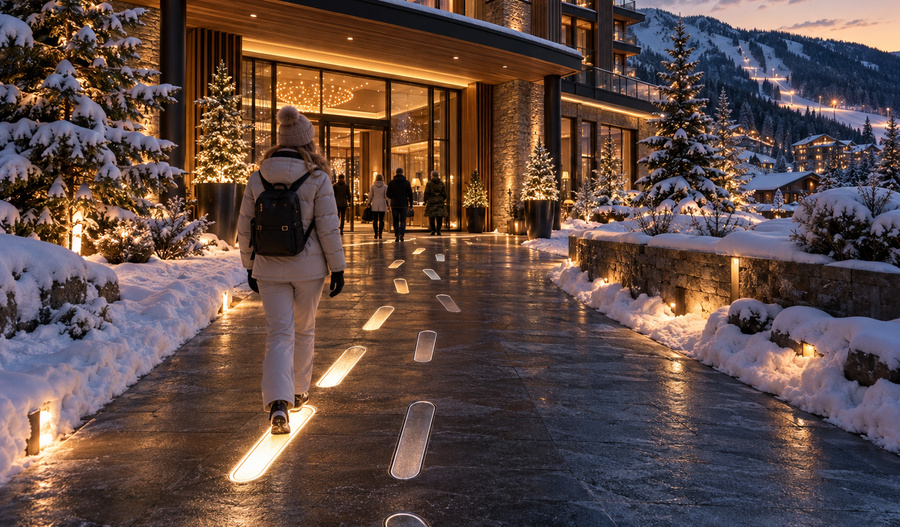
One way to create an unusual design for the entrance area of a ski resort is to build lighting elements directly into the pavement of the walkway.
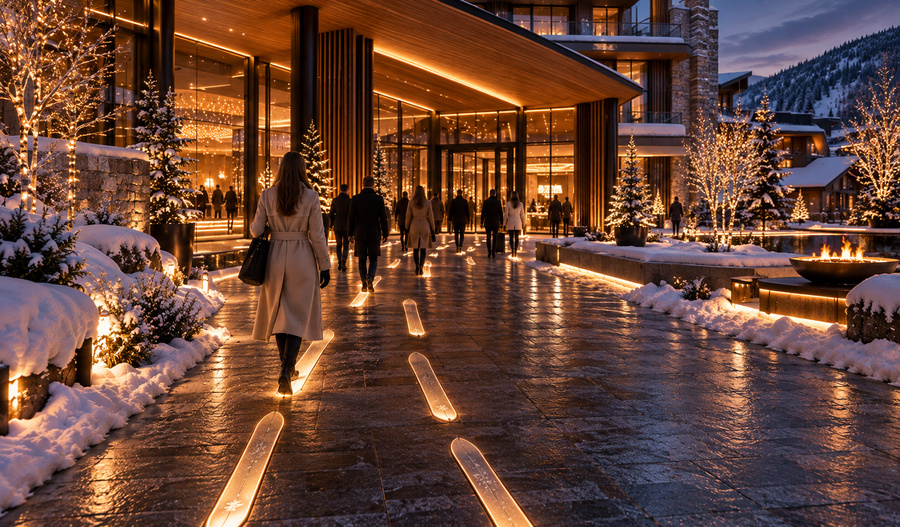
For example, lights shaped like ski tracks can be placed along a path. Normally, they remain off or emit a soft white light. When a visitor steps on one, a sensor activates the lighting.
A sequence of glowing trails follows a person as they walk toward the hotel. You can program various scenarios: the light follows the guest, changes color with each step, or gradually fades behind them.
The shape of the skis can also be used as part of the resort’s history. For example, you can recreate the silhouettes of classic wooden skis, modern sports equipment, or models associated with a particular era.
In this way, the ordinary entrance path becomes an interactive route that also reinforces the hotel’s ski theme.
For outdoor use, it is necessary to provide frost-resistant lighting fixtures, a slip-resistant surface, and a system designed to handle snow, moisture, and regular cleaning of the walkways.
Interactive architectural art installations in front of the hotel entrance
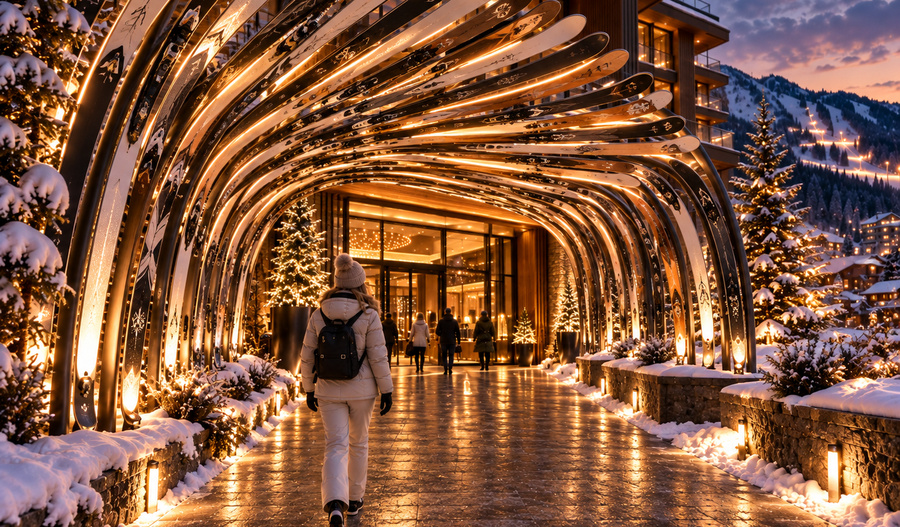
The entrance area can continue the story told by the resort itself. Instead of a traditional decorative canopy, an architectural art installation can be created here that reflects ski culture and the unique characteristics of the specific location.
For example, a structure made up of repeating ski-shaped elements that form a striking spatial composition above a pedestrian walkway.
At the same time, skis can vary greatly—from historic wooden models to modern sports designs. You can explore the history of skiing, the traditions of different eras, or famous athletes associated with the resort.
Built-in lighting and interactive These controls allow you to change the nature of the composition. The lights can turn on sequentially as visitors approach, follow their movements, or operate according to a pre-set sequence.
This design combines architecture, artistic vision, and functional lighting. With the appropriate engineering solution, it can also serve as a canopy that protects part of the pedestrian route from precipitation.
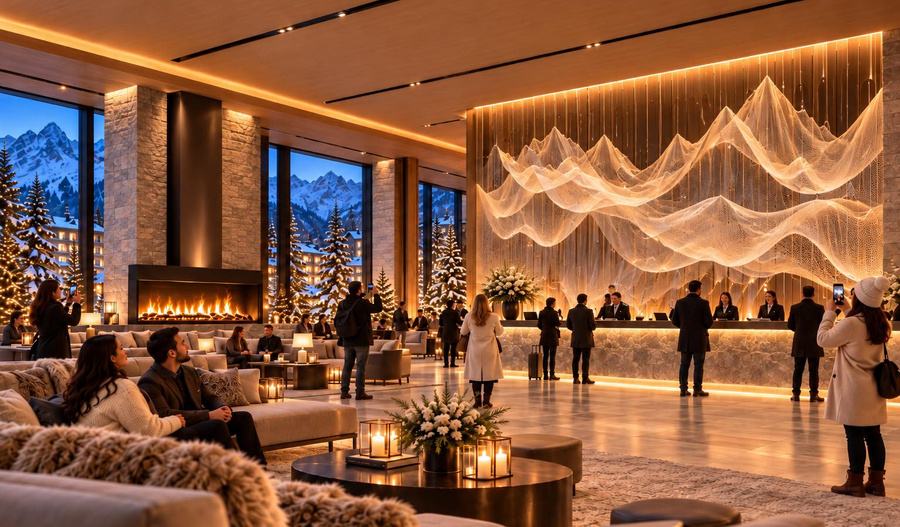
Kinetic Walls for the Reception Area: A Mountain Landscape Made of Fabric and Movement
You don’t have to use complex mechanical structures or expensive decorative panels to decorate the wall behind the front desk.
An interesting solution could be kinetic fabric wall, which is driven by a system of compact motorized winches.
Imagine a wide piece of fabric secured at several points. Each point is connected to a separate lifting mechanism. When the winches start operating, sections of the fabric rise and fall to different heights, gradually forming a three-dimensional relief.
For example, using ten adjustable suspension points, you can create a composition that resembles a mountain range. The number of mechanisms and the mounting configuration are selected based on the wall’s dimensions, the fabric’s properties, and the desired level of detail.
For each hotel, a custom motion program can be designed to replicate the distinctive silhouettes of the mountains near the resort or an abstract mountain landscape.
Programmable control allows you to create multiple scenarios. The fabric can slowly change its texture, transition from one composition to another, or stop in a specific position.
Architectural lighting adds depth. Directed light highlights the folds in the fabric, creating shadows that shift as the surface moves.
This kinetic wall can be incorporated behind the reception desk or in the waiting area. It takes up relatively little space in the room, yet creates a striking architectural feature.
Seasonal Decorations at Ski Resorts
Many ski resorts are open in the summer as well, so it’s a good idea to plan the design with the different seasons in mind.
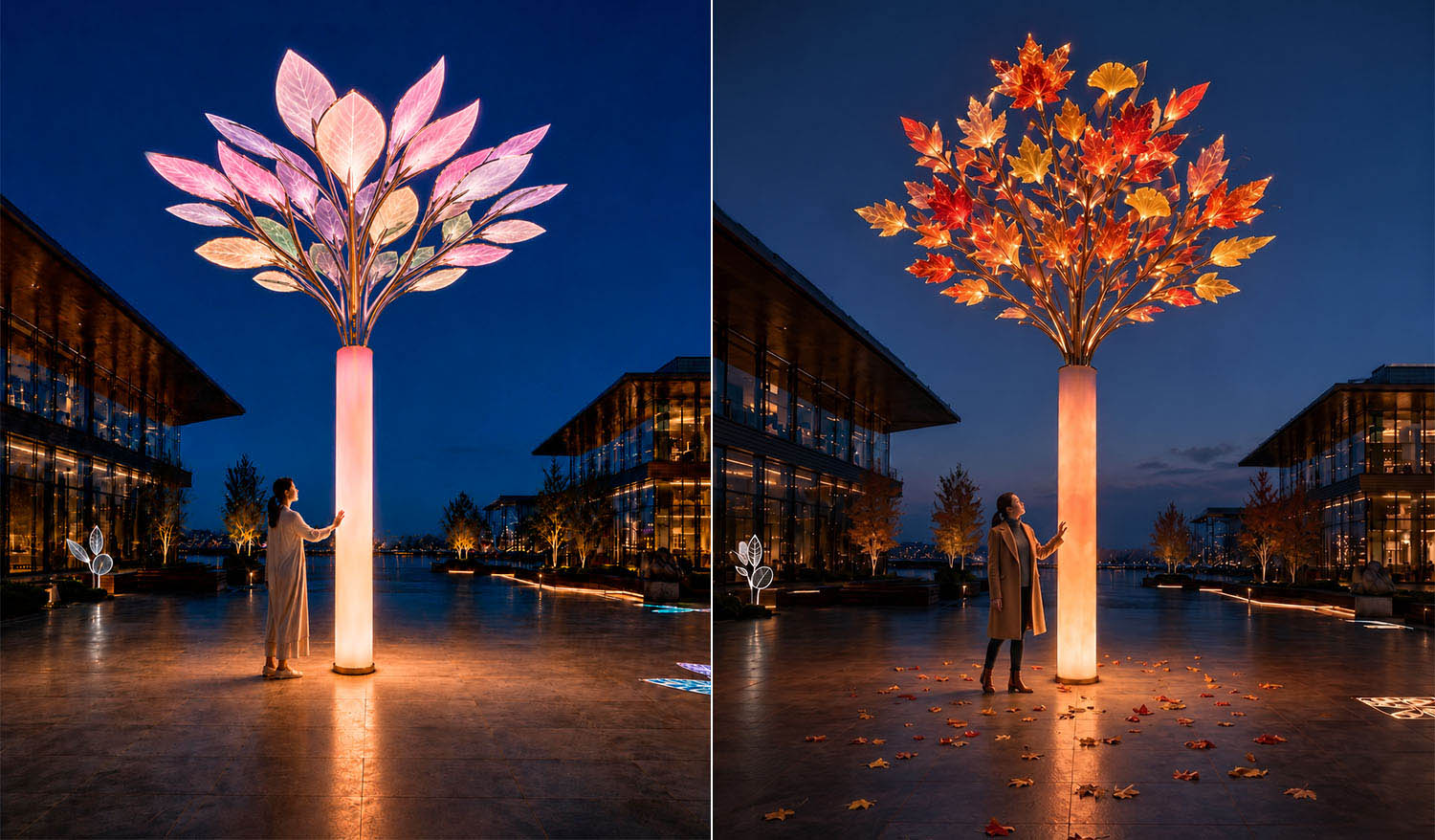
Kinetic systems with interchangeable hanging elements allow you to update the displays according to the season. In winter, snowflakes can float beneath the ceiling; in spring, floral shapes; in summer, nature-inspired elements; and in fall, arrangements of leaves and pinecones.
Programmable lighting enhances this capability. For the winter season, you can use cool white and blue tones; for the summer, a warmer palette; and for holidays and special events, you can create custom lighting scenes.
At the same time, the basic structure, control system, and mounting points remain the same. This makes it possible to change the visual design of the space without having to replace the entire installation on a regular basis.
Hotel Branding Through Interactive and Kinetic Art
When designing an art installation, it is important to take into account the architecture of the space and the identity of the hotel itself.
Corporate colors, the logo, the building’s history, distinctive features of the local natural environment, and the silhouettes of the surrounding landscape can serve as the basis for an artistic concept.
For example, a kinetic ceiling could incorporate shapes inspired by the resort’s natural surroundings. A kinetic wall behind the reception desk could replicate the contours of the nearest mountain range. And an interactive entrance walkway could draw on the history of skiing or the cultural traditions of the area.
A brand-specific color palette can be integrated into lighting scenarios, and the movement patterns can reflect the hotel’s atmosphere and positioning.
As a result, the art installation becomes a recognizable part of the architecture. Guests remember it and associate it with a specific location, while the hotel itself gains an artistic element designed exclusively for its space.
Contact Us
Are you ready to create an interactive installation designed for real-world urban environments? Check out our portfolio or contact the SKYFORM STUDIO team to discuss your project.
Developing an interactive installation in a dense urban environment goes beyond digital content and adaptive hardware. It requires an understanding of how sensor technologies, media, movement, architectural scale, and the rhythm of public life interact in real-world urban settings.
В SKYFORM STUDIO We design, develop, manufacture, program, and install interactive, kinetic, and media installations as integrated systems. We also create fountains and integrated water features when projects require a combination of motion, light, and controlled environmental effects.
Our work encompasses the entire process—from concept and visual design to engineering, motion systems, control software, manufacturing, and on-site commissioning—ensuring the reliable operation of each installation and its integration as an integral part of the surrounding environment.
Author of the article