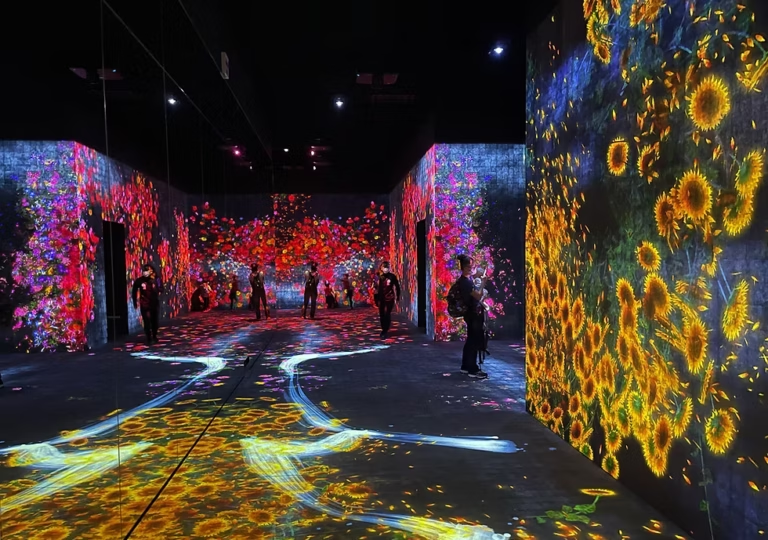
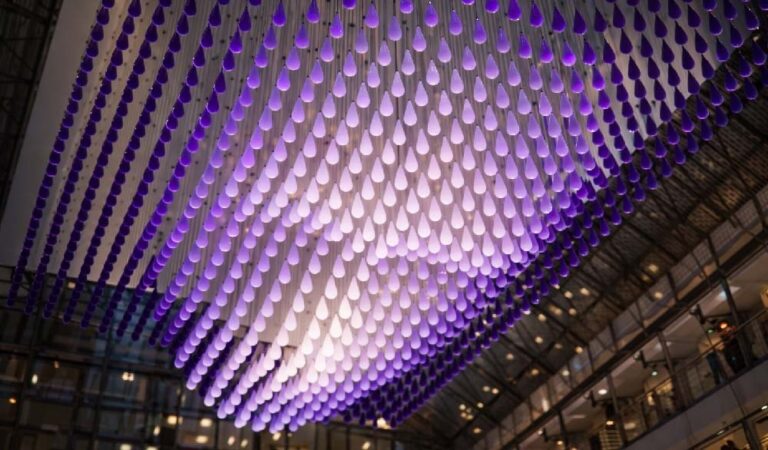
Kinetic art is often discussed through motion, transformation, and public experience. But in outdoor and semi-exposed environments, the real test of a kinetic installation begins when it enters weather. Wind, rain, humidity, thermal expansion, UV exposure, dust, salt, pollution, and seasonal contamination all begin acting on the system at once. In a static sculpture, these forces shape aging. In a kinetic installation, they shape behavior.
That distinction matters. Weather resistance in kinetic art is not only about preventing damage. It is about preserving motion quality under real environmental conditions. A work may remain structurally safe and still lose authority as an installation if movement becomes noisy, hesitant, irregular, visually degraded, or increasingly maintenance-dependent. In practice, many outdoor kinetic works do not fail dramatically. They fail behaviorally first.
For architects, developers, fabricators, and public art teams, this changes the engineering question. The goal is not only to protect the sculpture from climate, but to ensure that climate does not fundamentally alter the intended experience of the work. That requires weather to be treated as part of the design logic from the beginning — not as a late protective layer added after the motion system is already defined.
At SKYFORM STUDIO, this is one of the clearest distinctions between a kinetic concept and a kinetic installation that can truly perform in the world. Movement only retains credibility when the work is engineered for the environment it will actually inhabit.
Weather resistance is about behavior, not only survival
One of the most common misunderstandings in public art is to treat weather resistance as a simple question of outdoor durability. For kinetic work, that standard is too low. The real question is whether the sculpture continues to behave as intended through changing environmental conditions.
A kinetic installation can survive outdoors while already losing its integrity as a moving artwork. Bearings may pick up resistance. Control response may drift. Moisture may begin affecting joints or enclosures. Surface degradation may alter how the motion reads in light. None of these issues necessarily produce immediate structural alarm, but all of them affect how the work is perceived.
This is why weather resistance should be understood as behavioral resilience. The installation must preserve not only its material condition, but its motion character — its smoothness, quietness, precision, responsiveness, and visual coherence. That requirement changes the design process immediately. Materials, tolerances, joints, finishes, drainage, control logic, and maintenance access all need to be evaluated through the lens of operational behavior.
The best outdoor kinetic installations do not merely withstand weather. They continue to move with intent despite it.
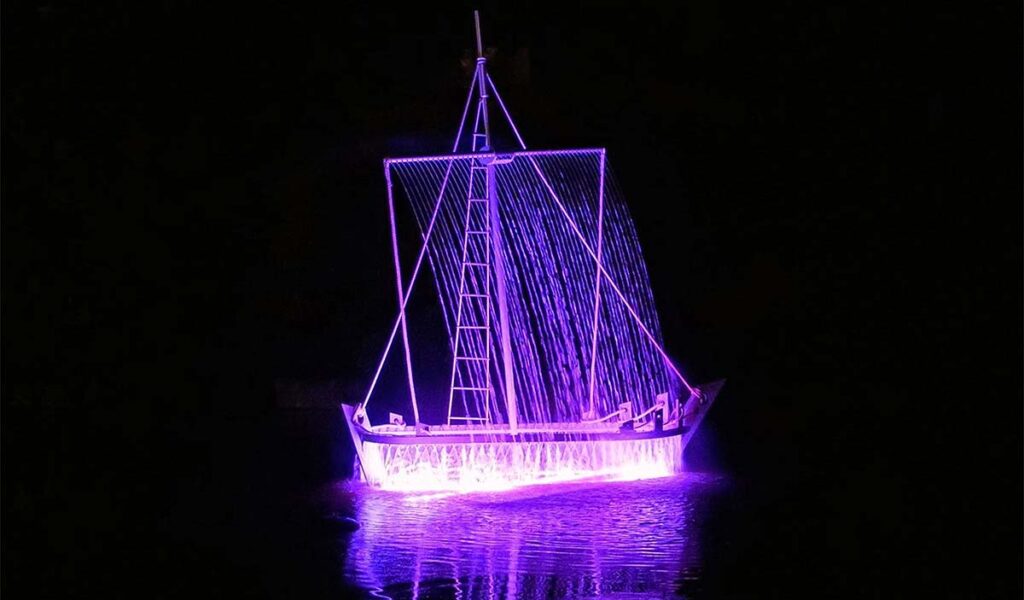
Wind is not only a structural load
Wind is one of the most complex forces in kinetic installations because it affects both structure and motion. In static sculpture, wind is primarily a loading issue. In kinetic work, it is also a behavioral variable. It can activate a passive system, distort a programmed one, overload moving components, amplify vibration, or introduce irregular movement that weakens the readability of the piece.
This becomes especially important in exposed plazas, waterfront sites, roof terraces, tall-building forecourts, and urban canyon conditions where air movement is rarely uniform. A sculpture may behave one way in open, steady airflow and very differently in turbulent zones near building edges or tower downwash. Large suspended fields, lightweight elements, and distributed moving arrays are especially sensitive to this.
Engineering for wind therefore means more than sizing supports. It means deciding how the work is meant to behave in real airflow. Should it visibly respond to wind, or remain stable against it? If it is wind-responsive, what range of motion remains legible and safe? If it is motor-driven, how should the system perform under gust conditions? What damping is required? How do support tolerances and moving interfaces behave under repeated lateral input?
A wind-sensitive sculpture can be beautiful. A wind-destabilized sculpture quickly loses credibility. The difference is engineering.
Water ingress is one of the most underestimated risks
Rain, humidity, condensation, and trapped moisture are among the most underestimated failure factors in kinetic installations. Water does not need to create obvious surface damage to be a serious technical problem. In moving systems, moisture affects bearings, joints, control enclosures, fasteners, hidden cavities, coatings, and electrical components long before the public sees a visible failure.
This is why weather resistance depends heavily on detailing. In many cases, the issue is not whether water reaches the installation, but where it goes afterward. If moisture enters a zone that cannot drain, dry, or remain isolated from sensitive components, it begins to affect long-term behavior. Poorly ventilated housings, trapped connection pockets, exposed cable entries, and badly resolved joint interfaces can all create persistent operational problems.
This is even more critical in moving assemblies, where repeated motion can degrade seals, expose edges, and create pathways for moisture to reach technically sensitive zones. Once inside, water often combines with dust, salt, or pollution, increasing both friction and corrosion risk.
Many outdoor kinetic works do not first deteriorate through dramatic visual damage. They deteriorate through wet internal conditions that slowly change how the system moves. That is why drainage, ventilation, enclosure logic, and inspection access are not minor technical details. They are central to the life of the artwork.

Temperature changes affect tolerances and motion quality
Thermal fluctuation is one of the most persistent pressures on outdoor kinetic systems, especially in climates with strong seasonal and day-night variation. Expansion and contraction may seem minor in isolation, but in moving assemblies even small dimensional shifts can affect alignment, clearances, friction, synchronization, and wear.
This becomes especially important in mixed-material systems, large exterior works, and installations requiring precise movement across multiple components. A sculpture that moves smoothly in workshop conditions may behave differently once exposed to full solar gain, nighttime cooling, or repeated freeze-thaw cycles. In certain climates, the problem is not exceptional weather. It is ordinary daily temperature change.
This is why outdoor kinetic works need tolerance strategies that are realistic across the full environmental range of the site. That affects joint design, housing dimensions, cable behavior, material pairing, and connection detailing. A system designed for a stable temperate environment may require very different engineering if placed in a desert climate, a cold continental city, or a humid coastal zone.
Weather resistance is always site-specific. A moving installation designed for Miami, Phoenix, Chicago, or Singapore cannot rely on the same assumptions.
UV exposure and surface aging affect more than appearance
Sunlight is often treated as a finish issue, but in kinetic installations UV exposure can influence much more than color stability. It affects polymers, seals, coatings, transparent elements, adhesives, cable jackets, and composite surfaces in ways that gradually alter both appearance and system behavior.
This matters because kinetic works often depend on materials and interfaces that are more sensitive than those found in static sculpture. If UV exposure hardens a seal, weakens a coating, embrittles a polymer, or changes a surface finish, the consequences may extend into motion quality and maintenance burden. In outdoor kinetic systems, visible aging and mechanical aging are often linked.
For this reason, UV stability has to be evaluated as part of long-term performance, not only visual preservation. A finish that looks convincing in samples may become difficult to maintain after prolonged exposure. A coating system may remain visually acceptable while hidden components degrade. An installation does not need to remain unchanged forever, but it does need to age without losing movement credibility.
That is a key distinction. Weathering is not automatically a problem. Uncontrolled weathering in a moving system is.
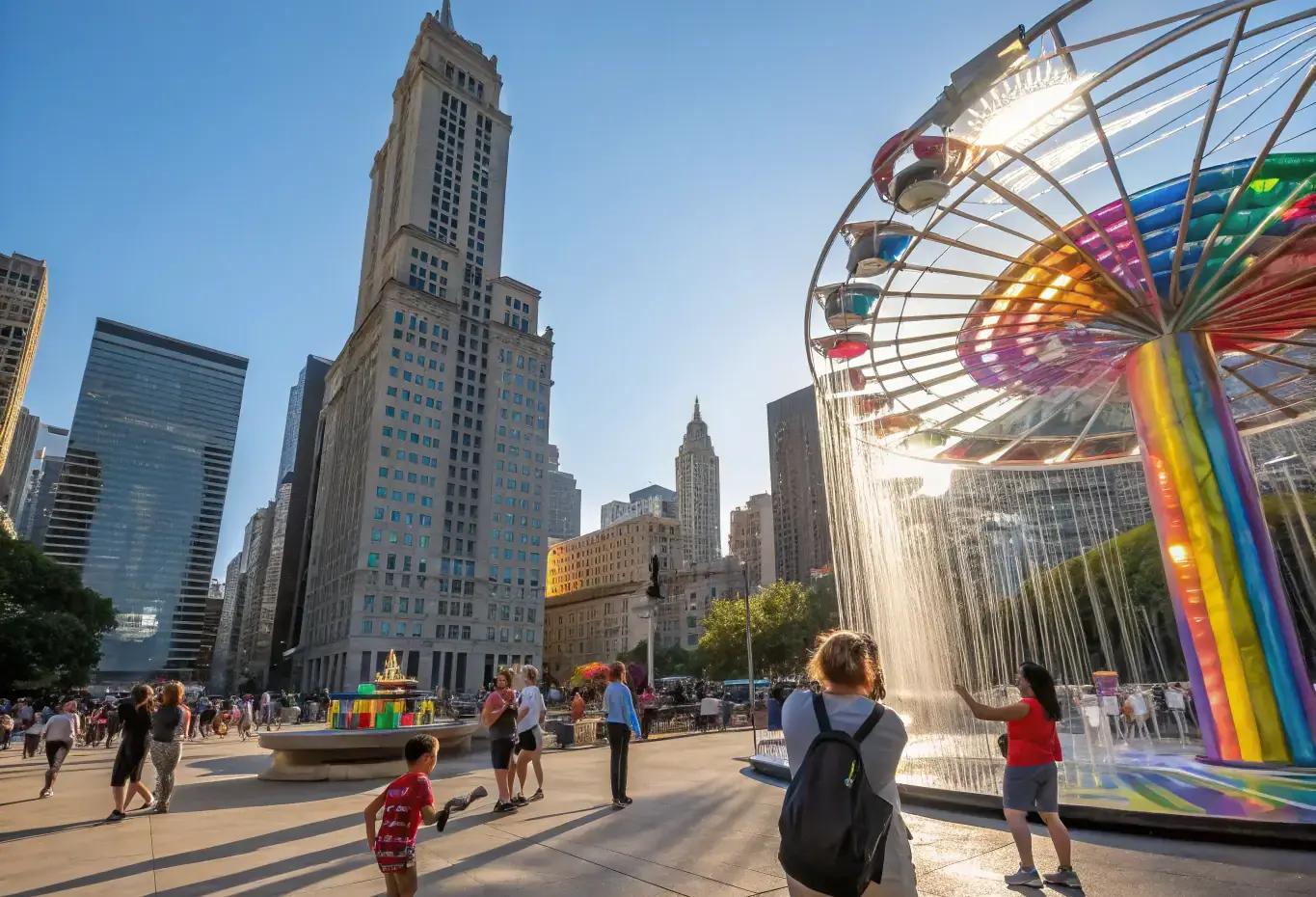
Dust, pollution, and airborne contamination are performance issues
Outdoor kinetic installations rarely operate in clean-air conditions. Dust, sand, pollen, soot, salt particles, biological residue, and urban pollution all accumulate over time, especially in moving interfaces, exposed joints, and lightly shielded mechanisms. In static sculpture this is mainly a cleaning issue. In kinetic systems it directly affects performance.
Contamination increases friction, changes wear patterns, affects sensing behavior, alters visible finish quality, and can degrade motion consistency. Fine particles reach bearings and sliding surfaces. Moisture binds contamination to the system and accelerates abrasion. Pollution combines with rainwater and metal interfaces to produce staining or corrosive residues. In some environments, the process is gradual but relentless.
This is why weather resistance also requires a contamination strategy. Where will dust settle? Which surfaces are exposed to runoff or splash? Can sensitive components be shielded without making maintenance impossible? How much contamination can the work tolerate between servicing cycles without losing motion quality?
These are practical design questions, not maintenance footnotes. Outdoor public works are rarely cleaned as often as ideal maintenance schedules assume. If the system depends on near-perfect cleanliness to perform convincingly, it is not truly weather-resilient.
Control systems must be weather-aware
In many contemporary kinetic installations, weather affects not only physical components but control behavior. Sensor-driven or programmed works do not operate in abstract digital space. They operate through enclosures, wiring paths, actuators, feedback systems, and environmental signals that all need to remain stable outdoors.
This makes weather resistance partly a control systems question. Temperature shifts affect electronics. Moisture can compromise connections or enclosure performance. Wind may change movement behavior enough to require different motion logic or fault thresholds. Sensor inputs may become inconsistent under rain, glare, condensation, or dust. In these works, reliability depends on how the control architecture manages environmental variability.
A visually simple installation may therefore require quite sophisticated environmental logic. The system may need to slow motion under higher wind loads, enter safe states during abnormal weather, recover predictably after interruptions, or filter unstable sensor input without producing chaotic behavior. If that logic is weak, the public reads the work as technically uncertain even when the cause is environmental.
This is one of the clearest reasons realization quality matters. Weather-aware controls are not “extra intelligence.” In many outdoor kinetic works, they are essential to preserving the artistic behavior of the installation.
Passive and active systems resist weather differently
Passive systems and actively driven systems do not confront weather in the same way. Each has distinct strengths and vulnerabilities.
Passive works — such as wind-responsive sculptures — reduce reliance on motors and control infrastructure, but they depend on environmental variability as part of their behavior. Their success relies on carefully balanced mass, damping, pivot behavior, and structural restraint. If they are too free, they become erratic. If they are too constrained, they stop reading as kinetic.
Active systems rely on motors, controls, and programmed motion. This gives greater predictability and choreographic control, but it also increases dependency on actuators, enclosures, wiring, calibration, and maintenance. They can resist environmental randomness more effectively, but they do so by introducing more components that need protection and service.
This means weather resistance is also a systems-choice issue. The right motion logic depends on the kind of behavior the work requires, how much variability the concept can tolerate, and what level of maintenance the client can realistically support. One of the most common strategic mistakes in outdoor kinetic art is selecting a motion approach for conceptual reasons alone without fully accounting for the climate and operational conditions it will have to live through.
Maintenance is part of weather resistance
Weather resistance is often described as if it were designed entirely into the object. In reality, long-term resilience depends just as much on inspection logic, replaceability, service access, and maintenance discipline. An outdoor kinetic installation that cannot be cleaned, adjusted, inspected, or repaired efficiently is not truly weather-resistant. It is merely weather-exposed.
This is especially important because most weather-related degradation is cumulative and localized. Bearings, seals, drainage points, fasteners, exposed interfaces, and enclosure transitions are where long-term problems usually begin. If these zones are difficult to reach or impossible to service without major disassembly, the work becomes harder to keep credible over time.
For this reason, maintenance is part of weather engineering from the start. Can technicians safely access the vulnerable zones? Can exposed components be replaced without dismantling the visible artwork? Are service intervals realistic for the climate and client? Can the installation tolerate deferred maintenance without immediately losing essential motion quality?
These questions matter because outdoor kinetic works are judged continuously in public space. A sculpture that feels hesitant, uneven, stained, or noisy may still be structurally sound, but it has already started to fail as an experience.
Reliability is what turns resistance into credibility
The public rarely evaluates weather resistance directly. Viewers do not inspect seals, drainage, or control enclosures. They notice whether the sculpture feels smooth or hesitant, coherent or compromised, precise or deteriorating. Reliability is what turns environmental resistance into public credibility.
That is the real standard for outdoor kinetic art. A weather-resistant installation is not simply one that remains in place. It is one that continues to move with the intended degree of clarity, control, and confidence across seasons. If weather gradually reduces that quality, the work loses authority even before it loses structural integrity.
For clients and design teams, this is why weather resistance should be treated as part of artistic realization rather than technical protection alone. It is what allows the sculpture to remain legible as a public work, not just as an object exposed to the elements.
Weather resistance in kinetic art installations is not only about protecting a moving sculpture from climate. It is about preserving behavior in real environmental conditions. Wind, water, temperature change, UV exposure, contamination, control instability, and servicing realities all influence whether a kinetic work remains precise, legible, and convincing over time.
For this reason, weather resistance has to be engineered as part of the installation’s total system. Materials, joints, finishes, structural detailing, motion logic, controls, drainage, and maintenance access all need to be designed with the actual site environment in mind. The stronger the integration, the more likely the installation is to retain both its movement quality and its public authority.
In the best outdoor kinetic works, weather does not gradually take control of the sculpture. The sculpture has already been designed to negotiate weather as part of its life. That is what turns a compelling kinetic concept into a reliable public installation.
Contact Us
Ready to create a weather-resistant kinetic installation built for real-world conditions? Explore our portfolio or contact the SKYFORM STUDIO team to discuss your project.
Designing a weather-resistant kinetic installation goes beyond selecting durable materials or protective finishes. It requires understanding how movement, environmental exposure, control systems, and maintenance will interact over time within a specific site context.
At SKYFORM STUDIO, we develop kinetic installations through an integrated process that connects motion concept, environmental performance, engineering strategy, fabrication, and long-term serviceability — ensuring reliability is embedded into the design from the very beginning.
For outdoor projects exposed to demanding conditions, the most effective moment to address weather resistance is during early planning — before system logic, detailing, and maintenance assumptions are fixed without engineering alignment.
Frequently asked questions (FAQ)
It means the installation can preserve not only structural integrity, but also its intended movement quality, finish performance, and operational reliability under real environmental conditions.
No. Materials matter, but weather resistance also depends on detailing, drainage, corrosion strategy, motion behavior, control logic, and maintenance access.
Because wind affects both structure and movement. It can activate passive systems, distort active ones, increase fatigue, and change how the installation behaves in public space.
They can be designed for manageable maintenance, but no outdoor moving system is truly maintenance-free. Weather resistance depends partly on realistic servicing and inspection over time.
As early as possible. It should be part of concept development and engineering strategy, not a protective layer added after the motion system and detailing are already defined.
Author of the article