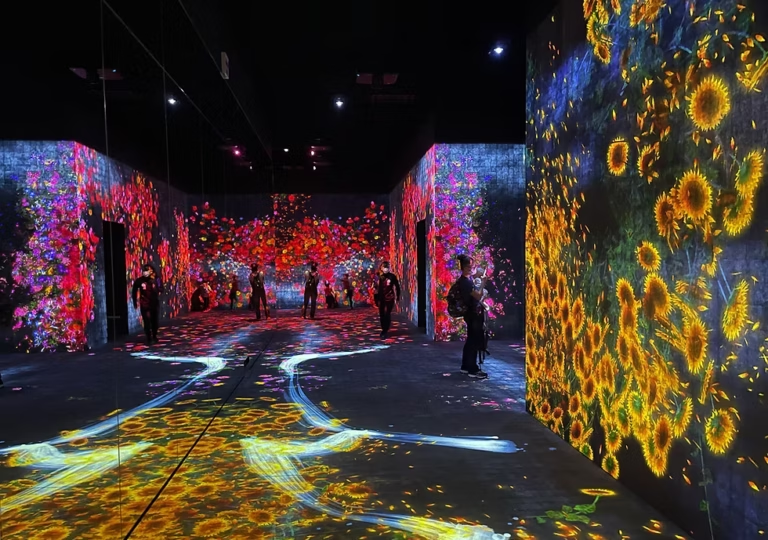
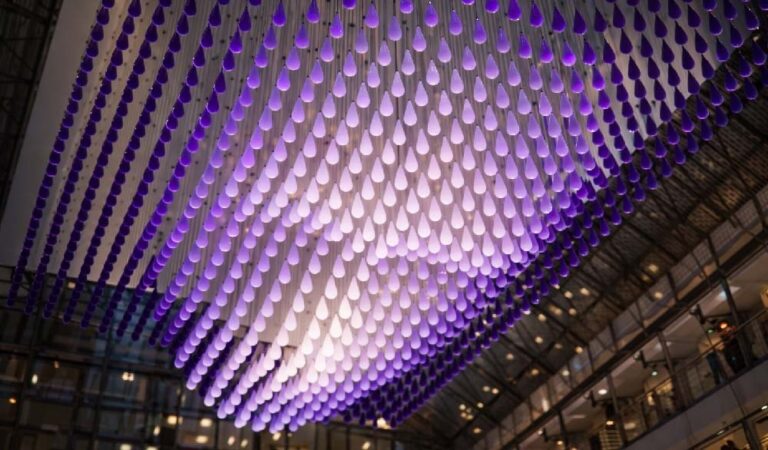
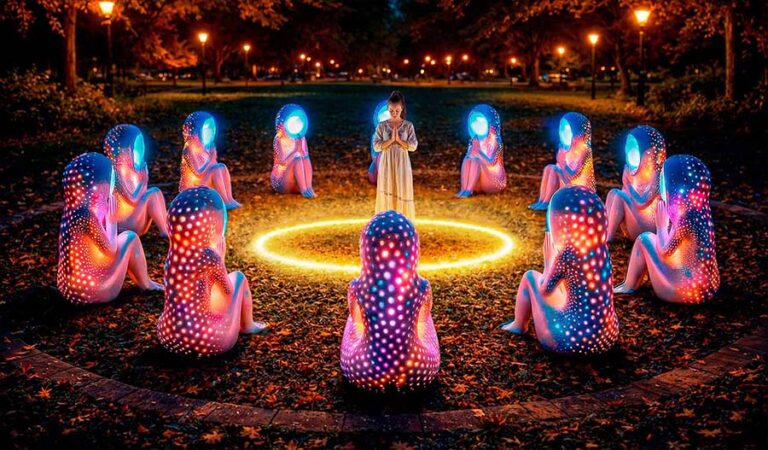
Interactive installations are usually described through what the public can see: motion, light, transformation, immersion, reaction. But interactivity does not begin with output. It begins with input. Before an installation can respond, it has to detect. Before it can transform, it has to register presence, movement, distance, sound, touch, environmental change, or data. This is the role of sensors: they form the input layer through which an installation perceives the world around it.
In contemporary interactive art, sensors are not secondary technical accessories. They shape the behavioral logic of the work itself. They determine what the installation notices, what it ignores, how quickly it reacts, how precisely it responds, and whether that response feels natural, spatially meaningful, or mechanically obvious. A sculpture that shifts in response to movement, a ceiling installation that changes with crowd density, or a media environment that transforms through sound or gesture all depend first on what the sensing system has been designed to read.
For architects, developers, curators, and design teams, this matters because the quality of interactivity depends less on the presence of sensors than on the intelligence of the sensing strategy. A system may be technically advanced and still feel crude if it reacts to the wrong input, responds too literally, or behaves in a way that conflicts with the atmosphere of the space. In the strongest interactive works, sensing is not a novelty feature. It is the foundation of a coherent relationship between people, environment, and artistic behavior.
At SKYFORM STUDIO, this input layer is where interactivity becomes credible. The question is not only how to make an installation respond. It is how to make it sense in a way that produces responses with clarity, atmosphere, and control.
Input quality determines response quality
An interactive installation is only as convincing as the relationship between what it detects and what it does with that information. Sensors can collect excellent data and still produce a weak experience if the system translates input too literally, too aggressively, or without enough spatial intelligence.
This is where many installations lose authority. They technically work, but they feel simplistic. A visitor steps closer and the work reacts immediately in a predictable way. A sound increases and the system mirrors it without nuance. A body enters the field and the installation announces that it has detected someone, but without building any real atmosphere. In these cases, the problem is not sensing capacity. It is behavioral design.
The real design question is therefore not which sensor is most advanced, but what kind of awareness the installation actually needs. Does the work need to know that someone is present at all, or how many people are present? Does it need distance, trajectory, speed, sound intensity, thermal signature, gesture, or broader occupation patterns? Once that is clear, sensor choice becomes much more disciplined.
In successful interactive work, the public does not experience a sensor event. They experience a relationship. The installation feels aware rather than reactive. That distinction is what separates a technical system from an artwork with responsive intelligence.
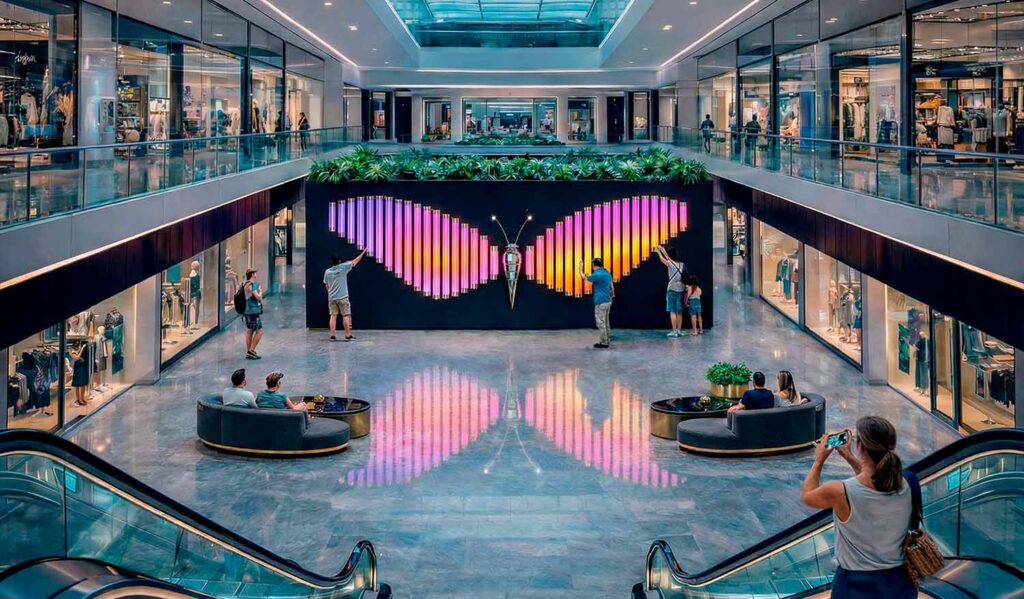
Presence detection and event-based activation
Some interactive installations do not need complex interpretation. They only need to know whether someone has entered a zone, crossed a threshold, or moved into a defined spatial field. In these cases, presence detection is often the right solution.
This kind of sensing is especially effective in entry sequences, corridors, controlled public interiors, gallery transitions, and lobby thresholds where the installation is meant to acknowledge arrival or activate a carefully timed moment. Its strength lies in decisiveness. The system can respond clearly without attempting to read more data than the concept actually needs.
What matters is how tightly the sensing field aligns with the architecture of movement. If activation occurs too early, the response feels detached from the user’s experience. If it occurs too late, the installation seems sluggish. If the field is too broad, it may trigger incidental motion in adjacent zones. If too narrow, it can miss the transition that the work is meant to emphasize.
Presence-based systems are often underestimated because they seem technically simple. In practice, they can be highly effective when the concept benefits from restraint. A slight shift in light, motion, or sound at the moment of entry can be more spatially powerful than a more elaborate system that never finds the right threshold of response.
Proximity sensing and gradual interaction
Where presence detection establishes whether someone is there, proximity sensing introduces distance as an active variable. That allows the installation to behave gradually instead of merely switching between inactive and active states.
This is useful when the concept depends on approach, hesitation, curiosity, or changing degrees of engagement. A sculpture may begin to shift as a visitor enters a wider field, then intensify as the person moves closer. A light environment may gain density with nearness. A media surface may reveal more structure as the distance collapses. In these works, the interaction unfolds across space rather than at a single trigger point.
Proximity sensing is often well suited to public lobbies, museum foyers, experiential retail, hospitality spaces, and civic interiors where the installation should reward movement through a spatial sequence. It can make interactivity feel continuous and bodily without relying on overt physical contact.
Its weakness appears when the response becomes too literal. If every step forward produces an immediately readable increase in activity, the installation can start to feel like a demonstrative device rather than an authored work. The best proximity-based systems avoid mechanical mirroring. They use distance as input, but interpret it through a more controlled behavioral language.

Motion tracking and occupation patterns
Some installations need to respond not to nearness alone, but to how people move through space. This is where motion tracking becomes essential. Rather than simply registering that someone is present, the system begins to understand trajectory, speed, direction, and shifting occupation across a larger field.
This allows the installation to behave spatially rather than reactively. A suspended kinetic field may ripple in relation to pedestrian flow. A media wall may register directional passage rather than isolated bodies. A responsive atrium installation may react to collective movement patterns rather than individual arrivals. In these situations, the work is no longer responding to a person as an object. It is responding to movement as a spatial condition.
This kind of sensing is especially valuable in larger environments such as atria, concourses, public halls, transport interiors, and large cultural spaces where occupation patterns matter more than intimate interaction. It is also useful when the installation is meant to reinforce the character of a public field rather than create a direct one-to-one dialogue with individual users.
The difficulty is not capturing movement, but deciding what matters within it. Raw motion data can overwhelm a system quickly. If the installation responds to everything, it becomes visually unstable. The strongest motion-tracking systems identify the level of behavior that is meaningful to the concept and ignore the rest.
Computer vision and visual interpretation
Computer vision extends sensing beyond simple detection into visual interpretation. It can allow an installation to read body position, gesture, crowd density, occupancy mapping, or other spatial characteristics derived from camera input.
This makes it especially useful when the installation needs more interpretive awareness. A piece may distinguish between one viewer and many, between dispersed occupation and concentrated gathering, or between slow approach and abrupt gesture. In these cases, the work can feel less like a triggered mechanism and more like an environment that is reading behavior.
But computer vision is also one of the easiest sensing strategies to misuse. It can create a false sense of sophistication if the installation collects more visual information than the concept can meaningfully transform. Excess sensitivity often weakens the work instead of deepening it. If every gesture produces obvious reaction, the system feels exposed. If the response is too complex for the viewer to perceive clearly, the sensing layer becomes invisible in the wrong way — not elegant, but unreadable.
There are also real site constraints. Camera-based systems are strongly affected by glazing reflections, changing daylight, backlighting, dark clothing against shadow, bright hospitality interiors, and reflective lobby surfaces. What performs well in a black-box demo can become unreliable in a daylight-filled atrium or a public foyer with shifting ambient conditions. Computer vision only becomes convincing when its environmental assumptions are realistic.
Audio sensing and acoustic responsiveness
Some installations respond to sound rather than movement. In these works, microphones or other audio sensors allow the system to register volume, pulse, frequency bands, or broader acoustic intensity. This produces a different type of interaction because the work responds to the energy of the environment rather than to position in space alone.
Sound-responsive systems are often effective in social spaces where public atmosphere matters as much as individual behavior. Hospitality zones, cultural foyers, gathering spaces, and event-oriented interiors can all benefit from installations that register collective acoustic presence rather than isolated triggers. In such settings, the work behaves more like an atmospheric instrument than a reactive object.
The challenge is acoustic instability. Reverberation, background systems, overlapping voices, music playback, mechanical noise, and open-plan spatial conditions can all distort what the sensor receives. That means the sensing strategy has to decide what kind of sound matters and what should be ignored. If every fluctuation in the room becomes visible response, the installation quickly loses composure.
The strongest sound-responsive systems therefore depend on filtering and threshold discipline. They are not designed to “listen” indiscriminately. They respond to specific acoustic conditions that support the intended emotional effect.
Touch, pressure, and direct physical contact
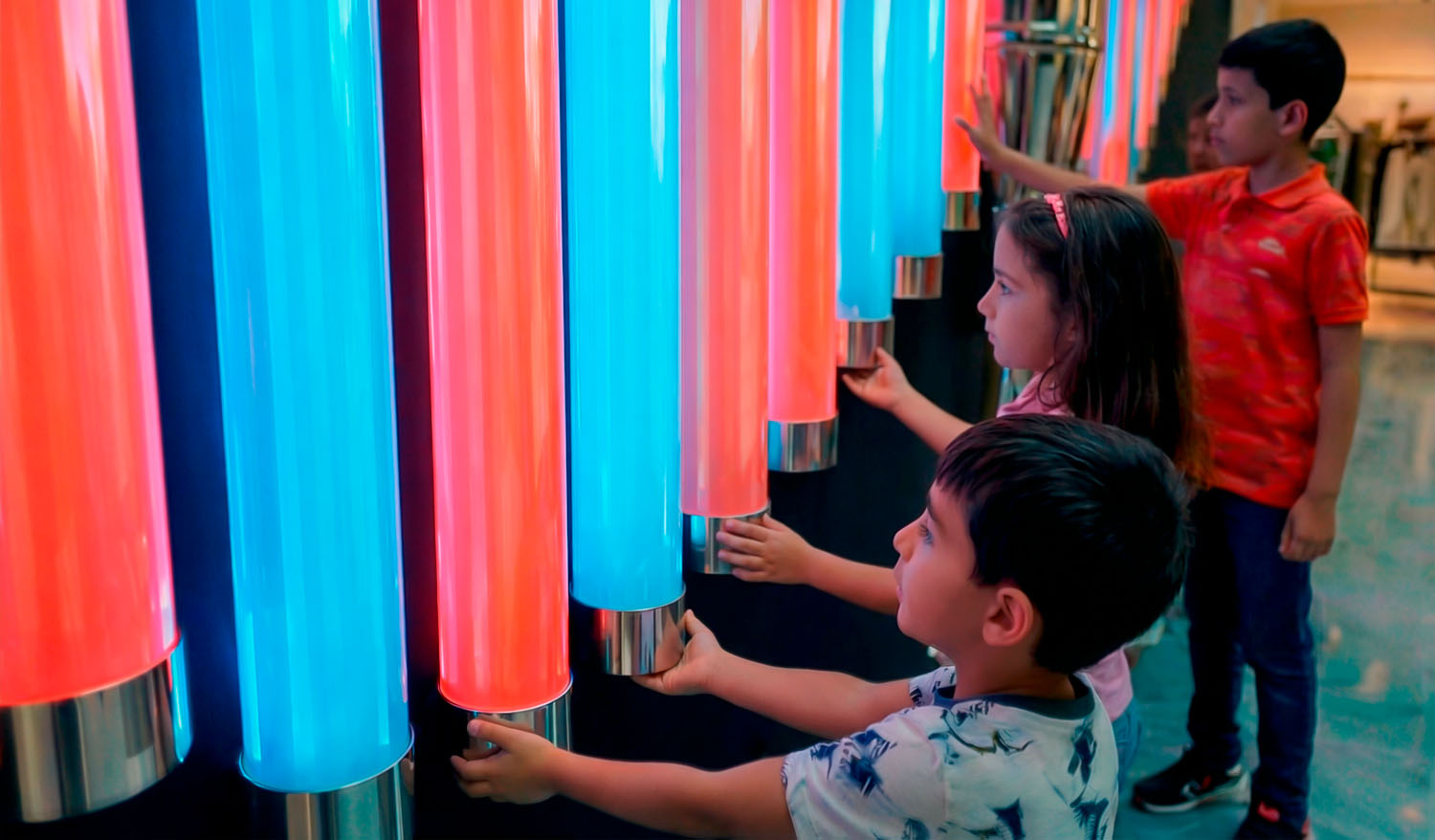
Some interactive installations are built around direct contact. In these works, touch sensors, pressure sensors, conductive surfaces, or embedded trigger points allow the public to activate the artwork physically.
This can create a stronger sense of intimacy and authorship than distant sensing systems. A touch-responsive work feels personal in a way that presence or proximity often does not. Pressure sensing can also be effective in floors, platforms, benches, and immersive environments where body weight and occupation are part of the concept itself.
But direct contact changes the design problem. Once touch becomes part of the installation’s behavior, the work has to be engineered for repeated contact, contamination, misuse, cleaning exposure, and irregular human behavior. A tactile system that performs elegantly in a low-touch gallery setting may become fragile in a public environment with high traffic and unpredictable use.
This is why touch-based installations are most convincing when the tactile layer is central to the identity of the work, not simply added as an extra interactive feature. If the system depends on contact, the contact logic has to be part of the artwork from the beginning.
Environmental sensors and site-responsive installations
Not all interactive works respond directly to people. Some respond to environmental conditions instead. Wind, daylight level, temperature, humidity, vibration, air quality, and other atmospheric variables can all function as input. This creates a different kind of interactivity, one in which the work responds to the site as a living system rather than to public triggering alone.
This approach is especially powerful when the installation is meant to deepen the relationship between artwork and place. A kinetic sculpture may shift with wind intensity. A light environment may change with the fading of daylight. A media-based work may translate environmental data into a public visual language. In these cases, the installation behaves less like a device reacting to users and more like an instrument that reveals otherwise invisible conditions.
Environmental sensing is especially relevant in façades, plazas, waterfronts, climate-exposed pavilions, and architecturally integrated works where site responsiveness has more meaning than direct touch or proximity. It can also create a subtler kind of interaction, where the public experiences the environment through the installation rather than controlling it explicitly.
Its challenge is interpretation. Environmental data does not automatically produce compelling behavior. A work that changes because the temperature changed is not necessarily meaningful unless that input has been translated into a perceptible and conceptually coherent response.

Sensor fusion and layered responsiveness
In more advanced interactive installations, one sensor type is often not enough. A system may need to combine multiple forms of input to behave with enough nuance. This is where sensor fusion becomes important.
Presence detection may be combined with proximity sensing. Motion tracking may be paired with sound input. Environmental conditions may shape the overall state of the installation while local public interaction affects shorter moments within it. This allows the work to operate on multiple levels at once and often makes the behavior feel richer and more stable.
But sensor fusion also increases complexity dramatically. Different sensors produce different types of data, at different speeds, with different levels of reliability under changing conditions. Integrating them well requires prioritization. If the system tries to respond equally to everything, the result is usually visual and behavioral confusion.
The strongest fused systems are therefore selective. They may sense many things, but they respond through a limited, disciplined behavioral language. In successful interactive art, more input does not create more value by itself. Better orchestration does.
In practice, the sensing layer is only one part of a larger interactive system. What matters just as much is how input is processed and translated into coherent behavior across motion, light, media, or show-control layers. In our own work, we use professional control and visualization tools, including MADRIX and Syncronorm, when a project requires reliable coordination between sensing, media logic, lighting, and real-time system response.
Sensor choice has to match the spatial logic of the work
A sensor can be technically accurate and still be wrong for the installation. The right sensor is not simply the one with the best specification. It is the one that matches the scale, movement pattern, public behavior, and architectural logic of the project.
A lobby installation intended to respond softly to approach may not benefit from crowd-tracking logic. A large atrium work designed to register collective occupation may be weakened by touch-triggered behavior. An outdoor installation in changing daylight may not support a sensing system that depends on highly controlled visual input. A ceiling field meant to respond to public flow may fail if it is structured around binary trigger zones rather than continuous spatial sensing.
Sensor selection therefore has to emerge from the concept of interaction, not from available hardware. The sensing method must correspond to the environment, the expected user behavior, the maintenance reality, and the type of awareness the installation is meant to express.
At SKYFORM STUDIO, this is where the technical strategy of interactive installations becomes decisive. The quality of responsiveness depends less on how many sensors a system contains than on whether those sensors form a coherent input architecture.
Reliability matters more than novelty
Interactive installations often fail not because they lack creativity, but because they try too hard to prove that they are interactive. The system detects too much, responds too often, or behaves too literally. The result is a work that may impress briefly but quickly loses subtlety and trust.
Reliability matters more than novelty because public responsiveness is judged through repeated experience. A convincing installation should remain composed under continuous use. It should not become chaotic when several people approach at once. It should not misread the space constantly. It should not feel like a device endlessly performing its own input-output logic.
That coherence depends on calibration, filtering, environmental testing, maintenance strategy, and the relationship between sensing and behavior. An installation that works beautifully in controlled demonstration conditions but becomes unstable in the real world has not been fully designed. Interactive art succeeds when its input layer remains robust under public unpredictability.
Sensors used in interactive installations form the input layer through which the artwork perceives people, space, sound, and environment. Presence detection, proximity sensing, motion tracking, computer vision, audio input, touch and pressure systems, environmental sensing, and fused sensor architectures all offer different ways of building responsiveness into a work.
But sensing alone is never enough. The quality of interactivity depends on whether the chosen sensor strategy matches the artistic concept, the spatial logic of the installation, the expected behavior of the public, and the technical realities of the site. In the strongest works, sensors do not make the installation feel more technical. They make it feel more aware.
That is what turns an interactive artwork from a reactive object into a coherent responsive environment.
Contact Us
Ready to create an interactive installation that responds with precision and clarity? Explore our portfolio or contact the SKYFORM STUDIO team to discuss your project.
Designing an interactive installation goes beyond selecting sensors that detect movement or presence. It requires building a sensing architecture that aligns with the concept, spatial conditions, and the behavior the installation is meant to produce.
At SKYFORM STUDIO, we develop interactive installations through an integrated process that connects sensing strategy, behavioral logic, media coordination, motion systems, and real-time control — ensuring that interaction feels coherent, responsive, and intentional.
Frequently asked questions (FAQ)
Sensors detect inputs such as presence, movement, proximity, sound, touch, or environmental change, allowing the installation to respond through motion, light, media, or other outputs.
Common types include presence sensors, proximity sensors, motion tracking systems, cameras for computer vision, microphones, touch and pressure sensors, and environmental sensors.
No. Many installations use simpler or more robust sensing systems such as proximity, presence, pressure, or environmental sensors depending on the concept and site conditions.
Because different sensors create different kinds of awareness. The success of the installation depends on whether the input system matches the intended behavior, environment, and scale of interaction.
Yes. Many advanced interactive works use sensor fusion, combining several input types to create more nuanced and stable behavior.
Author of the article