Ceiling kinetic installations occupy a very specific position in architecture. They do not behave like freestanding sculptures in plazas, and they do not function like façade systems embedded in the building envelope. Their field is the suspended zone above the public interior: atriums, lobbies, concourses, hospitality voids, museum halls, and large commercial gathering spaces. In that position, they operate simultaneously as artwork, spatial device, and engineered overhead systems.
This is what makes them such a distinct typology. A ceiling kinetic installation is never only an object placed overhead for visual effect. It changes how a room is read. It can compress or extend perceived scale, draw the eye upward, define the center of an atrium, slow public movement, or turn a neutral circulation void into a memorable interior landmark. In architectural terms, that is not decoration. It is a spatial intervention.
For architects, developers, and design teams, this matters because large interior volumes often suffer from a specific problem: they are expensive, generous, and technically impressive, yet spatially underdefined. Height alone does not create hierarchy. Light alone does not create identity. A suspended kinetic work can solve that condition when it is integrated early enough to shape how the volume is perceived and occupied.
Why ceiling installations are a separate architectural typology
Suspended kinetic works are governed by a different logic than ground-based installations. A sculpture in a plaza competes with circulation at eye level. A ceiling installation works through distance, vertical perception, and volumetric reading. The public does not encounter it as an object to walk around, but as an overhead field that alters the room itself.
That difference changes both its artistic role and its technical burden. The installation has to remain legible from below, from oblique entry views, from balconies or mezzanines, and often from long approach corridors. It must work at multiple viewing distances without dissolving into visual noise. It also has to operate within a tightly coordinated architectural environment involving structural spans, ceiling systems, smoke control, lighting hierarchy, maintenance access, and public safety.
This is why ceiling kinetic installations are closer to architectural systems than to conventional hanging artworks. Their success depends on whether they become part of the room’s spatial logic. If they are too small, they disappear into the volume. If they are too dense, they flatten the upper field and reduce clarity. If they are too mechanically expressive, they can make the space feel agitated rather than composed. The best suspended works calibrate scale, rhythm, and public attention without overpowering the room that hosts them.
What they do to space
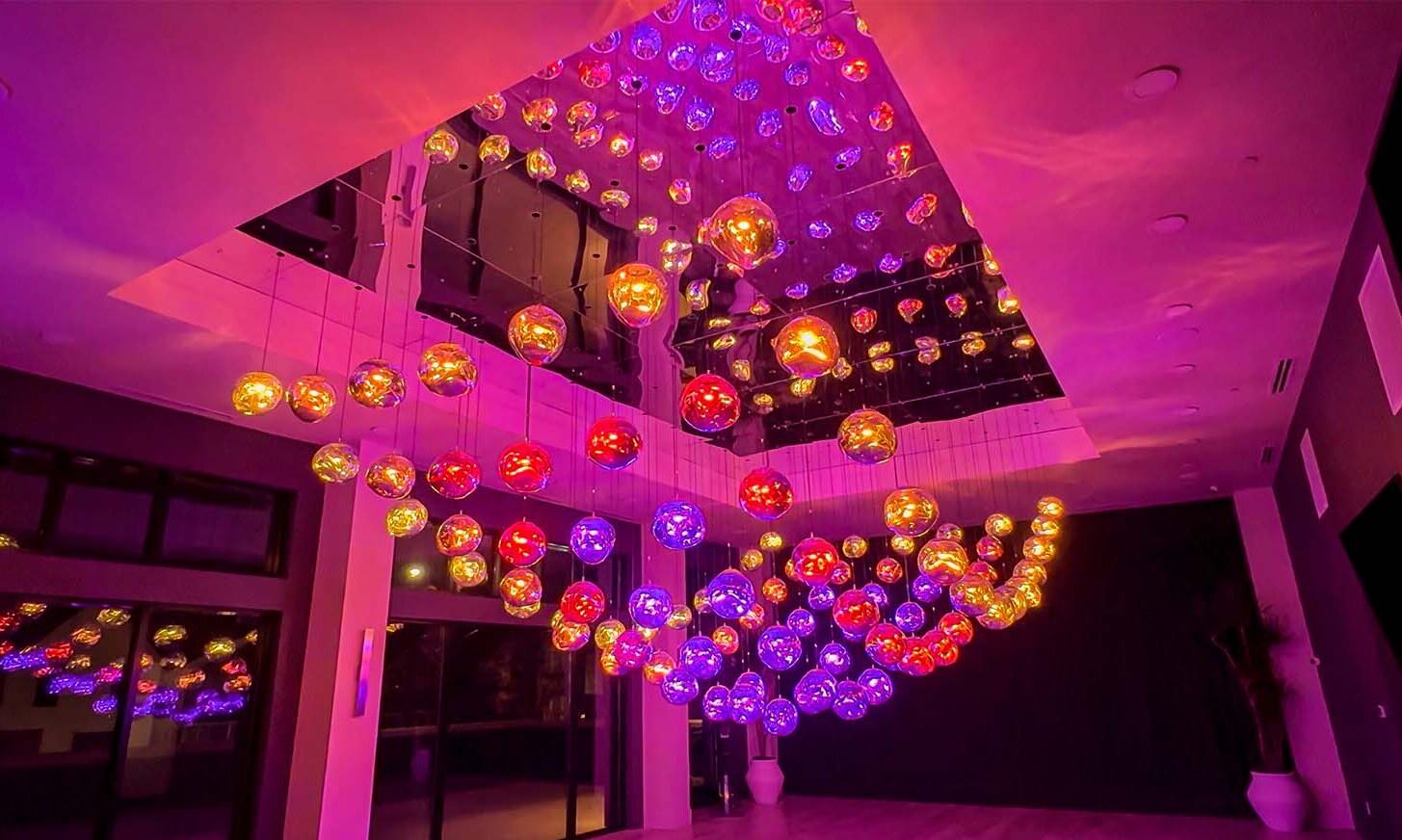
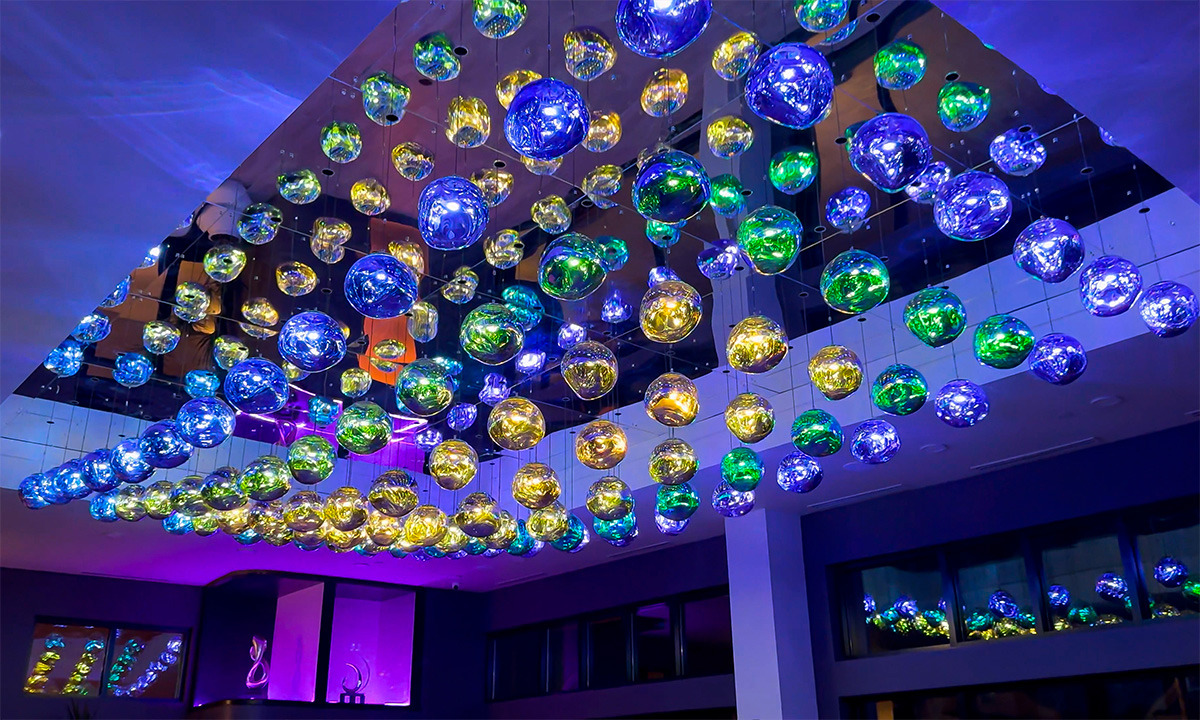
The strongest ceiling kinetic installations alter perception in three ways at once. First, they give the eye a reason to travel upward, which changes how the vertical scale of the room is understood. Second, they create a center of gravity in interiors that might otherwise feel diffuse. Third, they introduce time into the reading of architecture, so the space is no longer consumed in a single glance.
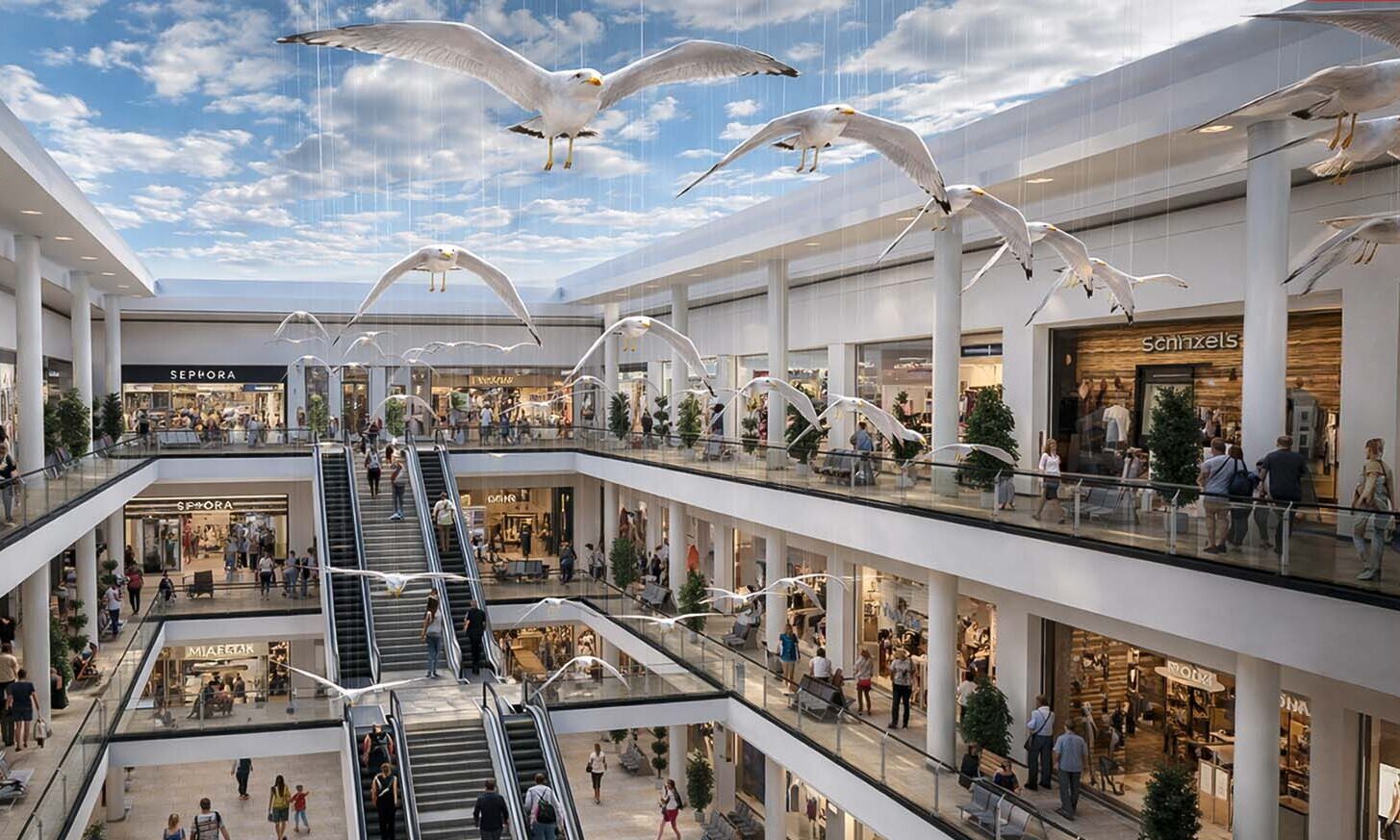
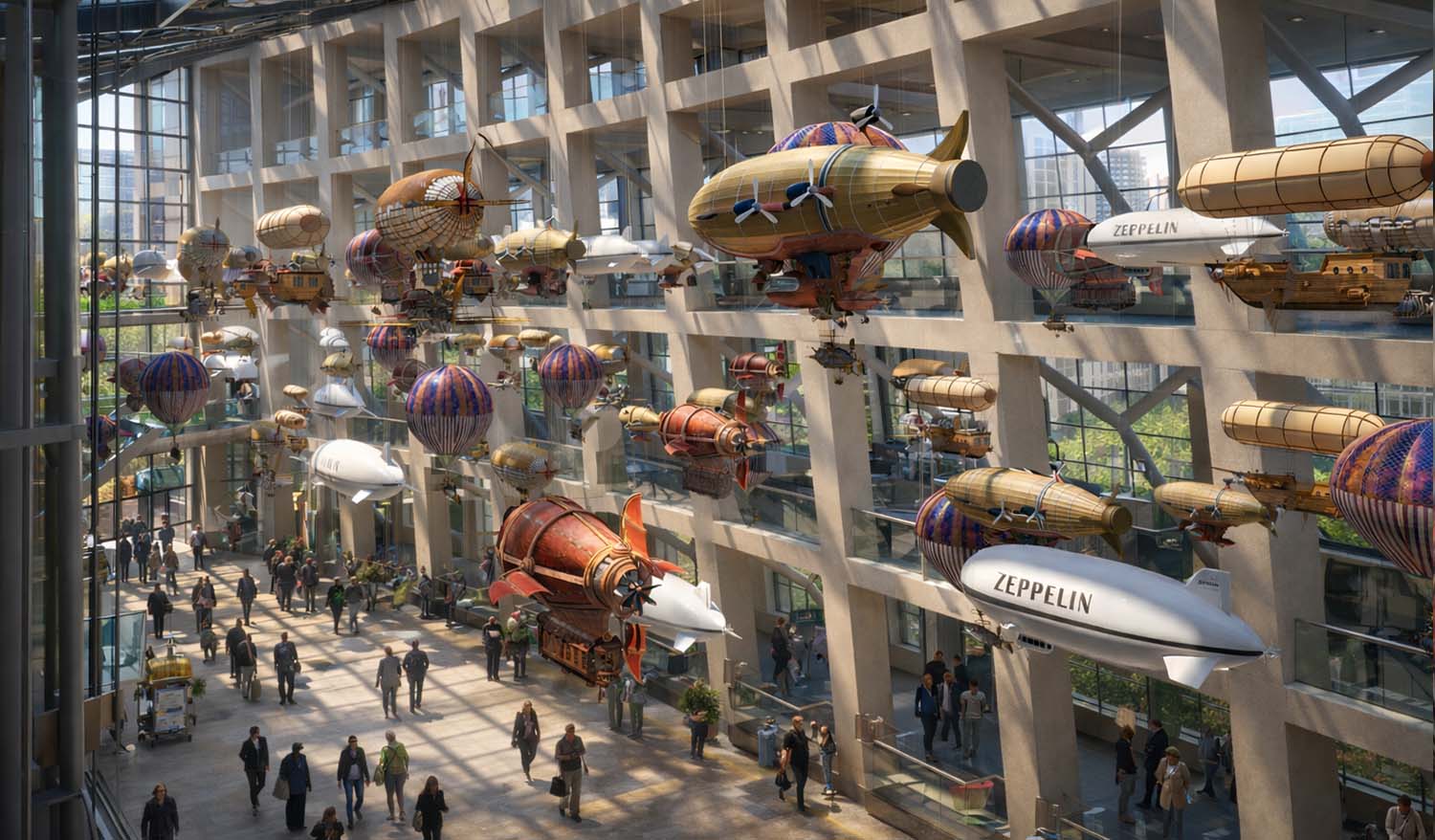
This is especially powerful in atriums and lobbies. Large commercial and cultural interiors often depend on double-height or multi-story volumes to communicate prestige, openness, or civic scale. But these same volumes can feel abstract if nothing structures them. A suspended kinetic field can make a tall room feel more proportioned and more intentional. It can visually connect ground level, bridges, mezzanines, and upper edges of the volume. It can also slow the act of looking, which is valuable in transitional spaces that might otherwise be understood too quickly.
The effect is behavioral as well as visual. When people enter a space with a compelling overhead installation, they pause differently, orient themselves more clearly, and read the room as a place rather than as a void. Passage space begins to acquire the qualities of stay space.
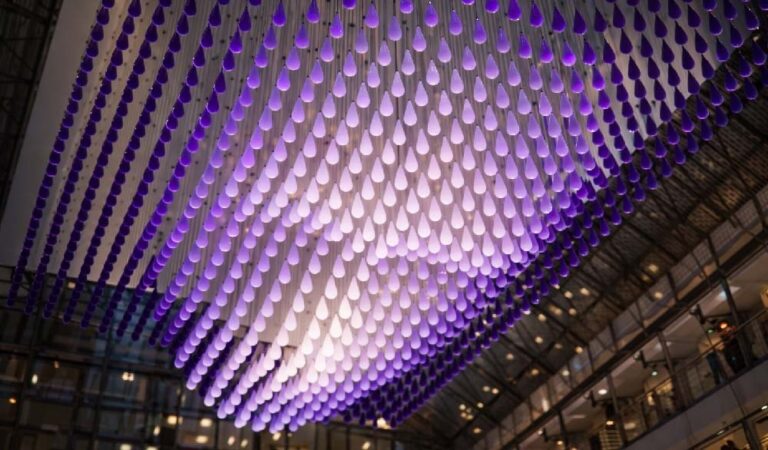
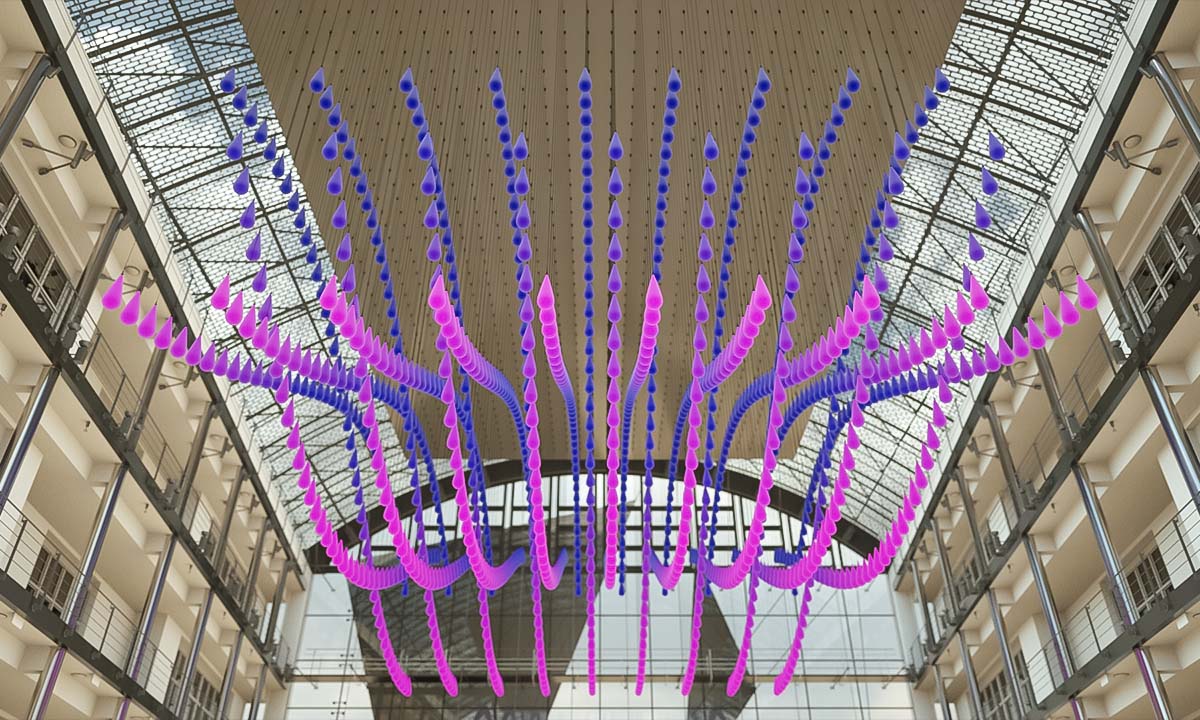
This is precisely why works like Slipstream by United Visual Artists at Heathrow Terminal 2 matter. It is not only a suspended sculpture in an atrium. It changes the way the terminal volume is perceived, giving the interior a stronger spatial identity at a scale that matches the architecture around it. That is the real power of this typology: it can turn overhead emptiness into a field of public meaning.
Atriums, lobbies, and concourses are not interchangeable
Although these environments are often grouped together, they demand different suspended strategies. In a corporate or hospitality lobby, the installation usually has to support arrival and identity. It may need to align with reception, arrival axis, or lounge zones, and it often carries part of the building’s public image. In a museum hall or cultural atrium, the installation may work more as a spatial event within a sequence of public experience. In an airport or transport concourse, it has to coexist with wayfinding, crowd movement, operational clarity, and long viewing distances.
These distinctions matter because the same overhead kinetic language will not perform equally well in all of them. A highly intricate suspended field that works beautifully in a contemplative cultural void may feel overcomplicated in a fast-moving transport environment. A dramatic central gesture that suits a luxury hospitality lobby may feel overly symbolic in a civic hall that needs broader spatial neutrality.
This is why ceiling kinetic installations have to be designed as site-specific typologies rather than portable concepts. The geometry of the room, the speed of occupation, the number of viewing levels, and the role of the space within the larger project all determine what kind of suspended motion will actually work.
The installation Loops by SpY in the atrium of the University Hospital in Bern is a good example. Its suspended illuminated rings do not simply fill airspace. They recalibrate the emotional and perceptual character of the atrium, which in a healthcare context matters as much as visual identity. That type of response would not necessarily translate directly into a transport concourse or speculative office lobby. Ceiling works succeed when they are typologically tuned, not generically impressive.
The engineering problem is not only suspension
One of the most persistent misconceptions about ceiling kinetic installations is that the main technical challenge is simply hanging the work. Suspension is only the beginning. The real difficulty lies in creating a moving overhead system that remains precise, safe, maintainable, and visually coherent within an active building environment.
Structure is obviously central. Loads have to be transferred to the host building without compromising the architectural volume. But beyond that, the installation often depends on concealed secondary steel, distributed support logic, cable routing, power and data pathways, servicing access, and exact control of tolerances across many suspended points. Once motion is introduced, the problem becomes more demanding. Dynamic loads, vibration, synchronization, and long-term fatigue all begin to matter.
In large suspended systems, the engineering challenge is often cumulative rather than singular. Small deviations at individual support points can become visible across the field. Minor tolerance drift can alter alignment. Limited access can turn routine maintenance into disruptive intervention. A suspended work that looks visually effortless may in fact rely on extremely disciplined coordination hidden above the visible plane of the room.
This is one reason ceiling kinetic installations fail when they are inserted late. The system may still be suspended, but not truly integrated. Sightlines become compromised, servicing becomes awkward, coordination with smoke control or lighting becomes secondary, and the installation starts behaving like an addition rather than a spatially resolved overhead system. In this typology, realization quality is inseparable from early architectural coordination.
Motion has to match the room
Not every kind of movement is right for an overhead installation. The motion language has to correspond to the architectural atmosphere of the space. In some interiors, subtle collective drift or slow transformation is enough to make the volume feel alive. In others, a more articulated sequence may be appropriate. But overhead motion carries more authority than motion at eye level because it occupies the upper field of the room. Even small gestures can therefore have large spatial consequences.
This is why restraint often matters more in ceiling installations than in other kinetic typologies. If movement is too abrupt, too fragmented, or too insistent, the installation can destabilize the room rather than animate it. It begins to feel like an event happening above the architecture instead of an extension of the architecture itself. If movement is too weak relative to the scale of the volume, the installation may visually disappear from most public viewpoints.
The strongest suspended systems understand this balance. They use movement to articulate the room, not overpower it. The goal is not to prove that something overhead is kinetic. The goal is to make the room itself feel more coherent, more memorable, and more spatially alive because of the way the installation behaves.
This is one reason overhead works often underperform despite strong visual concepts. The movement may be mechanically impressive but spatially indifferent. In an atrium, that usually means the work photographs well but does not actually organize the volume. In architecture, that is a lost opportunity.



Ceiling installations succeed or fail through integration
More than most art typologies, ceiling kinetic installations depend on early integration. Once the ceiling geometry, structural zones, smoke exhaust paths, lighting hierarchy, and maintenance access strategy are fixed, the room becomes far less adaptable. Trying to insert a moving overhead work late in the process often leads to exactly the same pattern: compromised sightlines, awkward support logic, inadequate servicing access, and a system forced to occupy leftover space instead of shaping the volume intelligently.
This matters most in commercial, cultural, hospitality, and civic projects where the installation is expected to do serious architectural work. If the goal is to define a lobby’s identity, structure an atrium, or create a memorable suspended landmark, then the installation has to be coordinated alongside the architecture, not after it.
This is also where the value of an integrated studio becomes most visible. Ceiling kinetic installations sit at the intersection of art, engineering, controls, fabrication, and architectural coordination. If those disciplines are separated too late or handled as parallel add-ons, the work usually loses either precision or spatial clarity before realization is complete.
At SKYFORM STUDIO, suspended kinetic systems are developed as spatial instruments rather than decorative objects. That difference matters most in exactly this typology, because overhead works are unforgiving: if the structure, motion, sightlines, and servicing are not resolved together, the room will reveal the weakness immediately.
Why this typology matters commercially
For developers and clients, ceiling kinetic installations have a distinct commercial advantage: they can create a strong identity without occupying valuable floor area. In atriums, hospitality interiors, commercial centers, transport spaces, and public halls, this matters. The installation works in the upper volume while keeping the ground plane open for circulation, retail visibility, seating, events, or operational flexibility.
That makes suspended kinetic works especially attractive in projects where the interior must perform both experientially and commercially. A ceiling installation can make a lobby memorable, a concourse more distinctive, an atrium more legible, or a public hall more shareable — all without reducing the flexibility of the room below.
This does not mean every interior needs one. It means this typology is valuable precisely because it can concentrate identity and spatial effect in a part of the room that architecture often leaves underused. When integrated well, it becomes one of the most efficient ways to add cultural and architectural force to a large interior.
It also means the commercial value depends on execution, not just concept. A suspended installation that becomes difficult to maintain, visually noisy, or spatially disconnected will not strengthen the room for long. The return comes when the installation works as a durable architectural asset rather than a one-time visual gesture.
Ceiling kinetic installations are a distinct architectural typology because they operate through vertical perception, suspended motion, and volumetric transformation rather than through object-based encounter. Their success depends on whether they help a room become more legible, more spatially structured, and more memorable over time.
They are most powerful in atriums, lobbies, concourses, and large public interiors where the upper volume has to do more than simply remain open. In these spaces, a kinetic ceiling work can become a landmark, a spatial anchor, a behavioral attractor, and an integral part of the architectural experience.
The best examples do not merely hang in the room. They give the room a new way of being read.
Contact Us
Ready to create a ceiling kinetic installation that defines the space from above? Explore our portfolio or contact the SKYFORM STUDIO team to discuss your project.
Designing a ceiling kinetic installation goes beyond suspending an artwork overhead. It requires understanding structure, motion, tolerances, sightlines, and maintenance — and how the installation operates within the architectural volume.
At SKYFORM STUDIO, we develop kinetic installations as integrated systems shaped by concept, movement logic, engineering, fabrication, and architectural coordination — ensuring each suspended work becomes part of the space rather than an addition to it. For large-volume environments, the most effective moment to introduce a ceiling installation is during early planning — before spatial and technical decisions are already fixed.
Author of the article