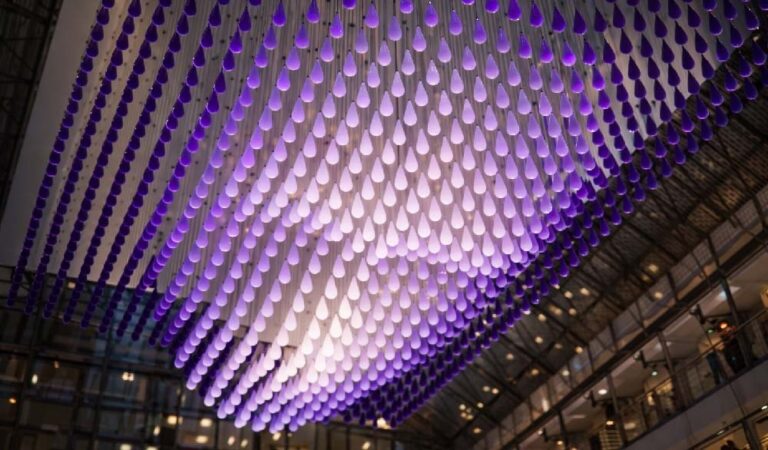
Kinetic sculpture is often discussed through its visible effect: movement, transformation, responsiveness, rhythm, surprise. But from an engineering perspective, none of those qualities are accidental. Motion in sculpture is never simply an aesthetic gesture. It is the result of structural calculation, mechanical logic, environmental response, control architecture, manufacturing precision, and long-term operational planning working together inside a highly constrained physical system.
This is what makes kinetic sculpture fundamentally different from static public art. A static object can succeed through proportion, material presence, and spatial placement alone. A kinetic work must do all of that while also moving reliably, safely, and meaningfully over time. It has to withstand load, vibration, fatigue, weather, servicing cycles, operational unpredictability, and public proximity without losing the clarity of its artistic intent. In that sense, engineering is not a technical layer added after the concept is complete. It is one of the conditions that makes the concept possible in the first place.
For architects, developers, fabricators, and design professionals, understanding how kinetic sculptures are engineered means understanding how motion is translated into built reality. The process is not only about motors and mechanisms. It is about how a moving work occupies space, how it is supported, how it behaves under stress, how it is controlled, how it is maintained, and how all of this is resolved without compromising the visual and spatial experience. In successful kinetic art, the engineering does not compete with the artwork. It gives the artwork its precision, credibility, and life.
It is also what determines whether a sculpture remains compelling after installation. Many kinetic concepts appear convincing in renderings and animations, yet fail during realization because movement quality, structural behavior, access for maintenance, or system reliability were never fully resolved. In practice, realization is where kinetic art either gains authority or loses it. This is why serious kinetic work cannot separate concept from engineering, or engineering from delivery.
Motion begins with the concept, not with the mechanism
One of the most common misconceptions about kinetic sculpture is that movement is added after the artistic idea is formed, as if the engineering process simply finds a way to animate an already finished object. In reality, the opposite is usually true. In strong kinetic work, motion is embedded in the concept from the beginning. The engineer is not merely solving for movement. The engineer is helping define what kind of movement is possible, legible, spatially effective, and structurally realistic.
This matters because not all movement produces meaning. A kinetic sculpture can rotate, tilt, fold, oscillate, ripple, or respond to external conditions, but the engineering logic has to support a precise choreographic intention. Is the motion continuous or episodic? Slow or abrupt? Collective or sequential? Symmetrical or variable? Driven by wind, motors, gravity, sensors, or programmed control? These questions are not only aesthetic. They immediately determine mechanical complexity, energy demand, fatigue behavior, control architecture, and maintenance implications.
At this early stage, the engineer is already shaping the artwork. A form that appears simple may require extremely tight tolerances to move correctly. A visually dramatic gesture may prove too structurally expensive or too maintenance-heavy for the intended environment. A subtle motion, by contrast, may deliver more spatial effect with far less mechanical burden. This is why the engineering of kinetic sculpture does not begin with hardware selection. It begins with defining the relationship between movement and meaning.
It also begins with deciding what should remain invisible. In sophisticated kinetic works, the viewer experiences motion as inherent to the sculpture, not as an exposed technical trick. Achieving that effect requires early decisions about concealment, access, support strategy, and the visual discipline of the system. In other words, the aesthetic success of the work is already an engineering question at concept stage.
Structure is never neutral in a moving sculpture
In static sculpture, structure can often remain visually silent. In kinetic sculpture, structure is always active, even when hidden. Every moving part introduces force, load transfer, resistance, dynamic imbalance, and fatigue. The sculpture is not just standing in space. It is changing its own structural condition through motion.
This is one of the central engineering challenges of kinetic work. The structure must carry dead loads and live loads while also accounting for dynamic behavior. A suspended kinetic installation, for example, may look weightless in motion, but its support system must deal with concentrated loads, shifting moments, cable geometry, connection tolerances, vibration control, and long-term fatigue in ways that a static installation does not. The movement itself changes the forces within the system.
This becomes even more critical at architectural scale. In atria, plazas, facades, and large public interiors, the sculpture often interacts directly with building structure. Suspension points, anchor frames, concealed secondary steel, service zones, and maintenance clearances all have to be engineered in relation to the host architecture. A kinetic work cannot simply be designed as a freestanding object and then placed into a building. Its structural logic has to be coordinated with slabs, beams, ceiling systems, glazing lines, wind exposure, access equipment, and service routes from the start.
For this reason, engineering a kinetic sculpture is often closer to designing a small machine integrated into an architectural environment than to engineering a static object. The sculpture has to remain visually coherent while behaving like a precise structural system under variable conditions. That balance between visual lightness and structural rigor is one of the defining challenges of the field.

Precision and tolerance define whether the work feels effortless
What distinguishes a refined kinetic sculpture from an awkward one is often not the concept, but the quality of its tolerances. Movement that appears fluid and inevitable usually depends on extremely disciplined engineering. Small misalignments can create friction, noise, vibration, visual inconsistency, drift, or cumulative wear that undermines the work over time.
Precision matters at every scale. In a small prototype, it determines whether a movement sequence reads clearly. In a large public installation, it determines whether dozens or hundreds of moving components remain synchronized, whether joints wear evenly, and whether the sculpture can maintain its intended behavior across repeated cycles. In other words, tolerance is not a fabrication detail at the end of the process. It is part of the design intelligence of the work.
This is why prototyping is so important in kinetic sculpture engineering. Digital models can simulate geometry and motion paths, but physical prototypes reveal how mass, friction, inertia, acoustic behavior, backlash, and component wear affect the actual experience of movement. A system that appears elegant in animation may feel unstable, noisy, or visually unclear in real space. Prototype testing allows the team to refine motion speed, joint behavior, actuation logic, tolerances, and structural response before the final system is scaled.
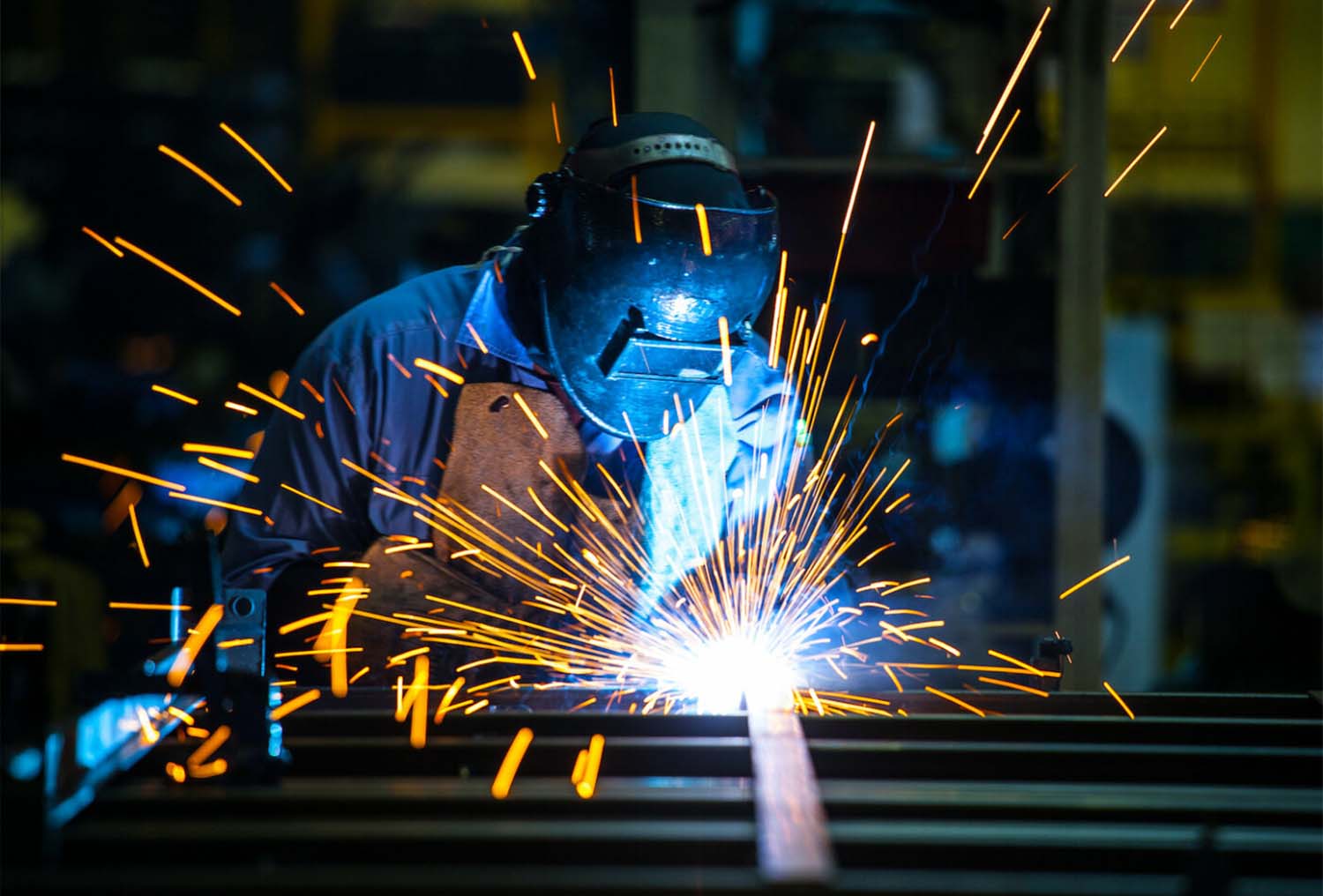
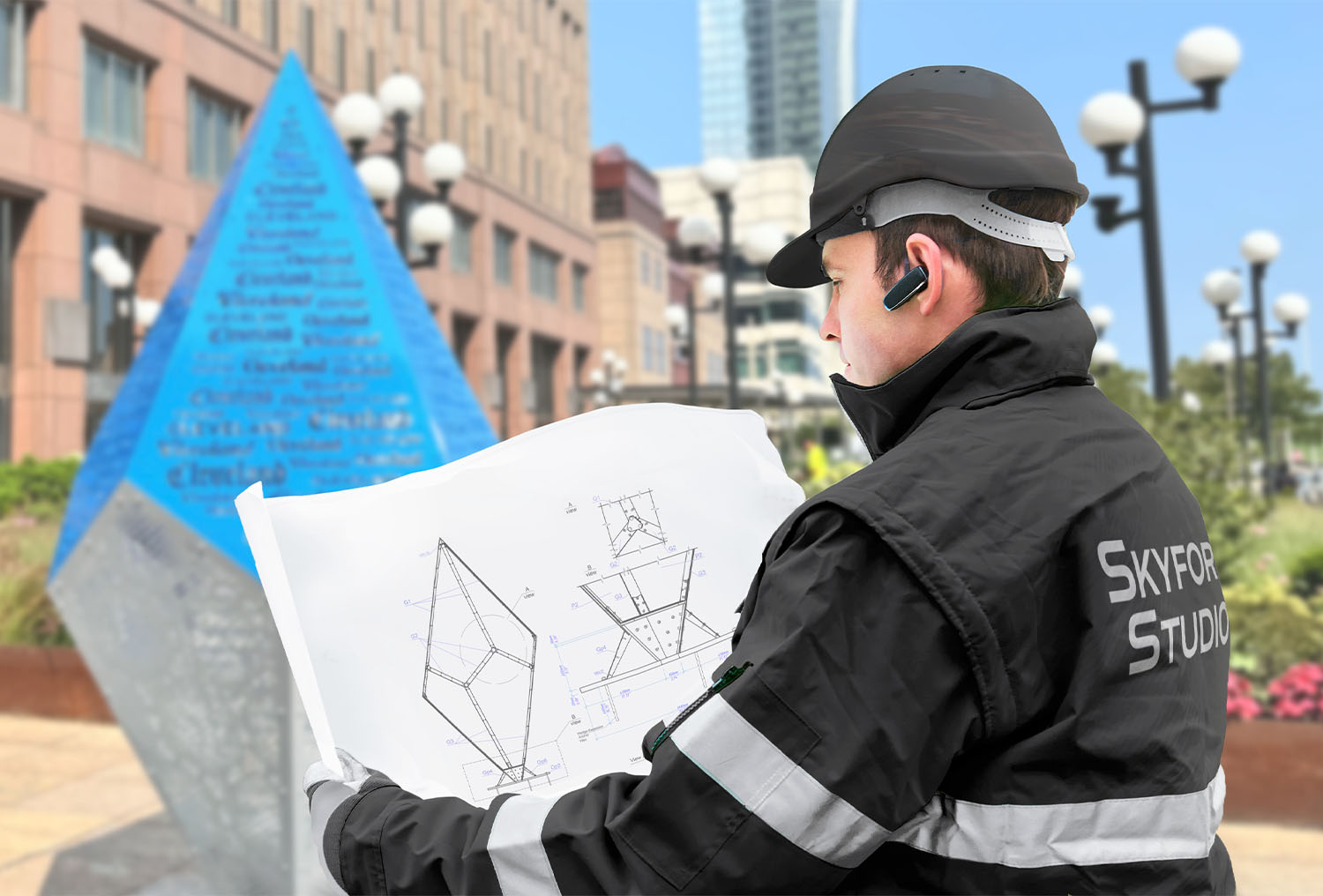
In realized projects, this discipline becomes even more important during fabrication and installation. Precision is not achieved once in the studio and then assumed to survive delivery. It has to be carried through manufacturing, surface finishing, assembly sequencing, transportation, site tolerances, and final commissioning. A beautifully engineered prototype can still fail as a built work if realization is not controlled with the same level of rigor.
At SKYFORM STUDIO, this relationship between visible ease and hidden precision is central to how kinetic work is developed. The smoother the sculpture appears in space, the more likely it is that engineering tolerances, material behavior, commissioning sequences, and control logic have been calibrated with extreme care.
Mechanisms are selected by behavior, not by trend
Another misunderstanding in kinetic art is the idea that there is a standard mechanical solution behind most moving sculptures. In reality, the mechanism is always specific to the required behavior. The engineering question is never simply how to make something move. It is how to make it move in the exact way the concept demands, within the environmental and architectural constraints of the site.
Different works rely on very different mechanical logics. Some use direct-drive systems for precise continuous motion. Others use belt, cable, gear, cam, or linkage systems to translate one type of movement into another. Some rely on balanced mass and gravity to reduce energy load. Others are designed as passive systems that respond to airflow or human presence. In each case, the engineer is selecting not only components, but a behavioral strategy.
This choice affects almost everything else. A gear-driven system may deliver precision but introduce noise or maintenance complexity. A cable-based system may allow elegant distributed motion but require tighter calibration and more regular servicing. A passive wind-responsive sculpture may reduce control infrastructure but increase uncertainty in performance. A sensor-driven interactive installation may create responsiveness at the cost of greater electronics, software, shielding, and service complexity.
The most appropriate engineering solution is therefore rarely the most technically elaborate one. It is the one that best aligns motion quality, reliability, maintenance reality, and artistic clarity. This is one reason highly sophisticated kinetic work often appears restrained. Engineering maturity is often visible not in technical excess, but in the discipline of the chosen system.
Material behavior changes when movement is involved
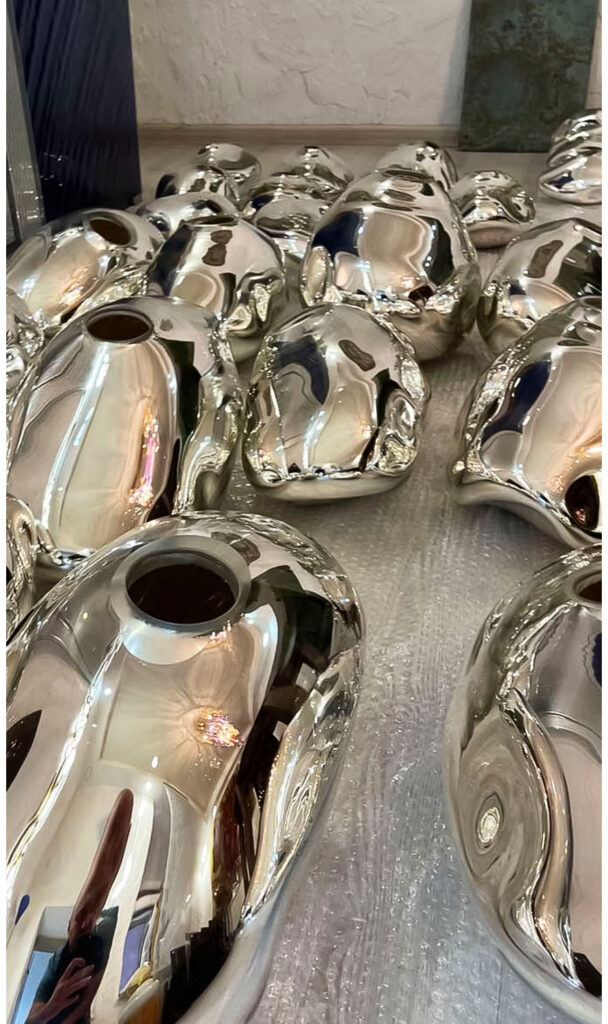
Materials in kinetic sculpture are not only selected for appearance. They are selected for how they behave under repeated motion, environmental stress, and long-term loading. A material that works beautifully in static sculpture may perform poorly once fatigue, flexibility, weight distribution, thermal movement, and surface wear enter the equation.
This is why material engineering in kinetic sculpture is so specific. Metals, composites, polymers, bearings, coatings, cables, and joint components all have to be judged not only aesthetically, but mechanically. Weight becomes especially important because mass affects motor load, response speed, inertia, structural demand, and energy consumption. Surface finish also matters beyond appearance. It can influence friction, corrosion resistance, maintenance intervals, and how the sculpture behaves in changing light conditions.
Outdoor works add another layer of complexity. Wind load, rain, temperature fluctuation, UV exposure, dust, humidity, and salt can all affect long-term performance. A kinetic sculpture engineered for an internal atrium may rely on very different tolerances and materials than a large-scale public work in a coastal or desert environment. Weather resistance in kinetic sculpture is not only about protecting the surface. It is about preserving movement quality under environmental stress.
The engineer therefore has to think about materials as part of a performance system. Will the component creep over time? Will thermal expansion affect alignment? Will repeated cycles create fatigue at a joint? Will contamination alter bearing behavior or exposed mechanisms? Will coatings preserve appearance but increase maintenance complexity? These are not peripheral questions. In kinetic work, they are often central to whether the sculpture remains credible five years later.


Control systems shape the intelligence of motion
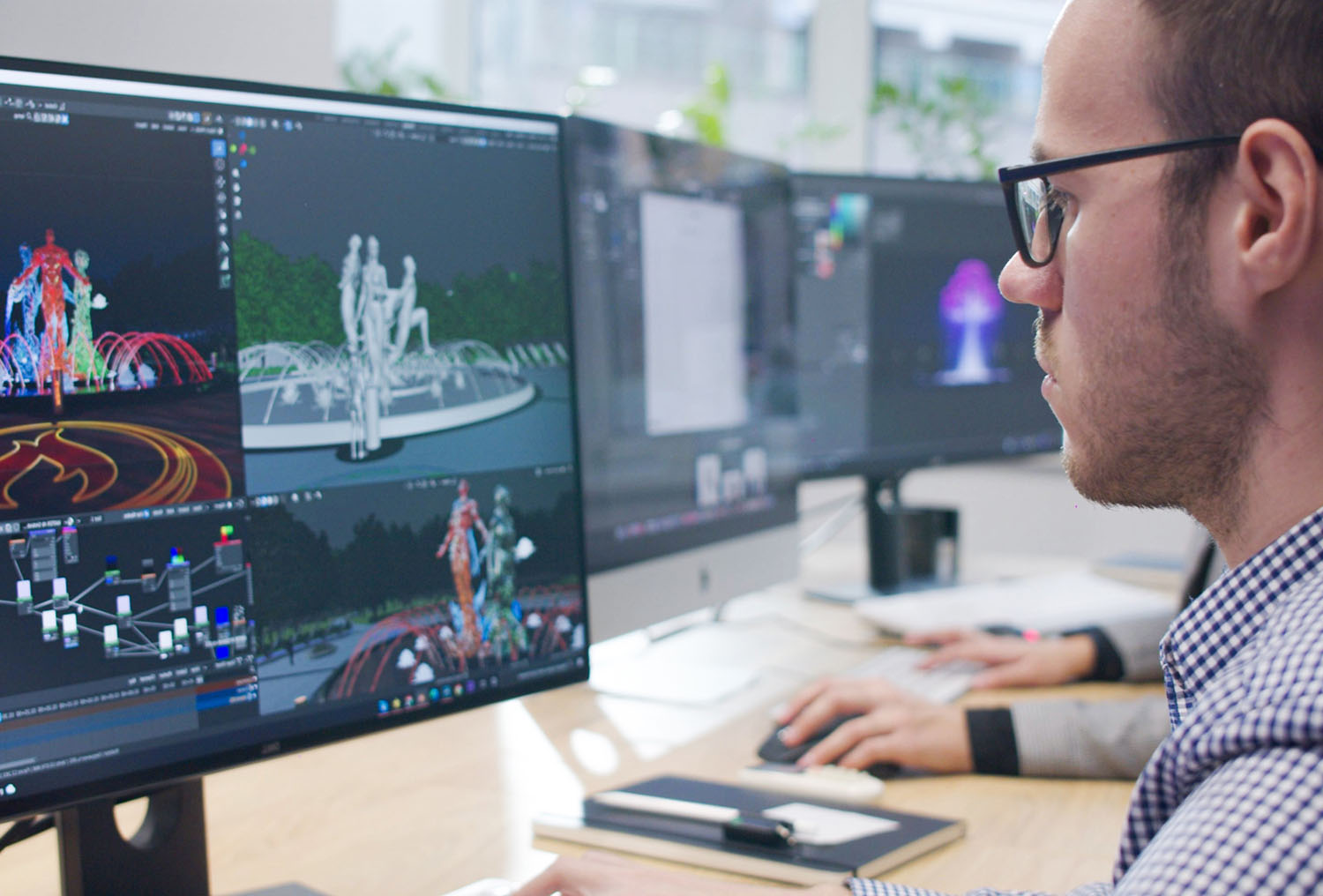
In many contemporary kinetic sculptures, movement is not only mechanical. It is programmed. This introduces another major engineering layer: control systems. Once a sculpture depends on timed sequences, responsive behaviors, synchronized components, or sensor input, the work becomes a hybrid of structure, machine, and software logic.
Control engineering determines how the sculpture behaves across time. It defines motion sequences, speed variation, start-stop conditions, acceleration curves, synchronization logic, pause intervals, responsive triggers, fault states, and operational safety. In more complex works, it also shapes how motion interacts with light, sound, environmental input, or human presence. The sculpture is no longer just moving. It is operating.
This has important implications. A visually simple installation may require highly sophisticated control logic to appear calm, seamless, and responsive. If the control logic is poorly resolved, the sculpture may feel mechanical in the wrong way — too abrupt, too repetitive, too noisy, too literal, or simply out of rhythm with the surrounding space.
Engineering here is not about making the work visibly technological. It is about making the movement behave with enough precision and consistency that the technology disappears into the experience. That is often the real standard of success in kinetic systems.
It also means that control systems must be engineered for reality, not only for ideal conditions. Power interruptions, sensor instability, environmental drift, component wear, and maintenance overrides all have to be accounted for. A sculpture that moves beautifully in demonstration mode but becomes unreliable under real operating conditions has not been fully engineered. Commissioning, diagnostics, and recoverability are part of the system design, not postscript technical concerns.
Safety is integral, not corrective
Any public kinetic installation has to resolve safety at the same level as form, motion, and structure. This is especially true in large public environments where viewers may pass beneath, approach closely, or occupy the same space as the sculpture. Safety in kinetic engineering is not simply a matter of compliance added after design. It is inseparable from the design logic of the piece.
This includes structural redundancy, movement limits, controlled clearances, emergency stop conditions, load path reliability, public interface control, and maintenance-safe servicing. It also includes questions of human behavior. How close can viewers come? What happens if they reach, touch, gather beneath, or behave unpredictably? How are moving components visually legible from below or from oblique angles? How does the installation behave in abnormal or failure states?
The engineering response to these questions has to be built into the work from the beginning. A kinetic sculpture that is safe only because its behavior has been drastically reduced late in the process will usually lose clarity as an artwork. The better approach is to develop movement, structure, access, and public interface together so that safety does not weaken the conceptual quality of the piece.
Why realization fails when engineering is treated as a separate stage
One of the most frequent reasons kinetic projects fail is the assumption that engineering can remain downstream from artistic design. This often leads to a familiar sequence: the concept is fixed visually, the desired motion is described in broad terms, and only then is an engineer or fabricator asked to “make it work.” In kinetic sculpture, this approach almost always introduces compromise.
When engineering is isolated from concept development, movement quality tends to suffer first. The system becomes heavier, noisier, less precise, or more mechanically visible than intended. Then buildability problems appear. Connections become difficult to service, tolerances become unrealistic for scale, access routes are poorly resolved, and the installation starts depending on late corrective decisions rather than integrated design. By the time fabrication begins, the work may still be buildable, but it is no longer behaving as originally imagined.
This is why realization should be understood as part of design authorship in kinetic art. Buildability is not a later technical fix. It is part of the conceptual intelligence of the work. The same is true of commissioning, operational logic, maintenance access, and long-term replacement strategy. When these are introduced too late, the sculpture may still exist as an object, but it rarely achieves the coherence of a genuinely engineered kinetic system.
For clients, this distinction matters enormously. A kinetic sculpture is not successful because it moved on opening day. It is successful because it continues to perform with precision, clarity, and reliability under real conditions. That outcome depends on integrated realization thinking from the start.
Maintenance is part of the engineering logic
Kinetic sculptures are not finished when they are installed. They are ongoing systems. This makes maintenance one of the core engineering concerns, not an afterthought. The most visually refined work can become unreliable or visually compromised if it is difficult to access, difficult to service, or overly dependent on delicate components in a demanding environment.
This is why serious kinetic engineering always includes maintainability. Bearings, motors, linkages, control cabinets, cables, lighting elements, access points, and replacement strategies all need to be considered as part of the system architecture. Can the work be serviced without dismantling major elements? Are the parts standardized or entirely custom? Is the control system diagnosable? Can the sculpture fail safely and recover predictably? Can routine servicing happen without damaging finishes or disrupting the surrounding architecture?
These questions are especially important in commercial and public settings where downtime affects not only operation, but the credibility of the place hosting the work. A sculpture that is technically impressive but operationally fragile may satisfy an idea of innovation while undermining the confidence of owners, operators, and users.
A well-engineered kinetic sculpture does not merely move beautifully on opening day. It is designed so that beauty can be preserved operationally. That requires a level of engineering discipline that is often invisible to viewers but decisive for clients, architects, and developers evaluating realization quality.
Engineering is what allows movement to feel inevitable
The most successful kinetic sculptures share a particular quality: their movement feels inevitable. It does not feel arbitrary, over-mechanized, or merely animated. It feels intrinsic to the work. That effect is not a matter of artistic intuition alone. It is what emerges when concept, structure, material behavior, mechanism, tolerance, control logic, realization strategy, and maintenance planning have been engineered as one system.
This is why kinetic sculpture sits at such a specific intersection between art, architecture, engineering, and fabrication. It requires the artistic clarity to know what kind of movement matters, the architectural awareness to understand how the work will occupy space, and the engineering rigor to make that movement precise, durable, safe, buildable, and spatially convincing.
For a global audience of architects, developers, and design professionals, this is what makes kinetic sculpture so compelling. It is not simply a moving object. It is a designed choreography of forces made visible. And for clients looking to commission such work, it is also a reminder that realization quality is not separate from artistic quality. In kinetic art, they are inseparable.

Contact Us
Ready to create a kinetic installation engineered for real-world performance? Explore our portfolio or contact the SKYFORM STUDIO team to discuss your project.
Engineering a kinetic sculpture goes beyond making movement possible. It is about ensuring that movement is buildable, precise, maintainable, and credible at the scale of the final work. Within architectural environments, this requires aligning motion logic with structure, material behavior, and long-term operational conditions.
At SKYFORM STUDIO, we develop kinetic installations through an integrated process that connects concept design, motion logic, structural engineering, prototyping, fabrication, and realization planning. This approach ensures that technical decisions directly shape the precision, clarity, and reliability of the final installation.
Author of the article